
Last spring a seller in Kanawha County phoned me three days before closing. Her title attorney had just slid a withholding form across the table, one she’d never laid eyes on. She’d moved to Ohio back in 2019 and had no idea the rule existed. That’s typical, since the question of who pays taxes on a West Virginia sale usually doesn’t come up until the money’s already sitting there.
So let’s sort it out now.
Who Pays Taxes When Selling a House in West Virginia?
Get this wrong and your settlement statement shrinks by thousands on the day you least expect it. Most sellers who get burned weren’t lied to. Nobody asked who pays taxes at each stage of the sale, so nobody told them.
There are three separate buckets, and each one behaves its own way. First, the excise tax on the deed gets charged once, at recording. Property tax is already riding on your parcel, and you split it with the buyer. Income tax on any profit comes last, handled by the IRS and the West Virginia Tax Division months later when you file.
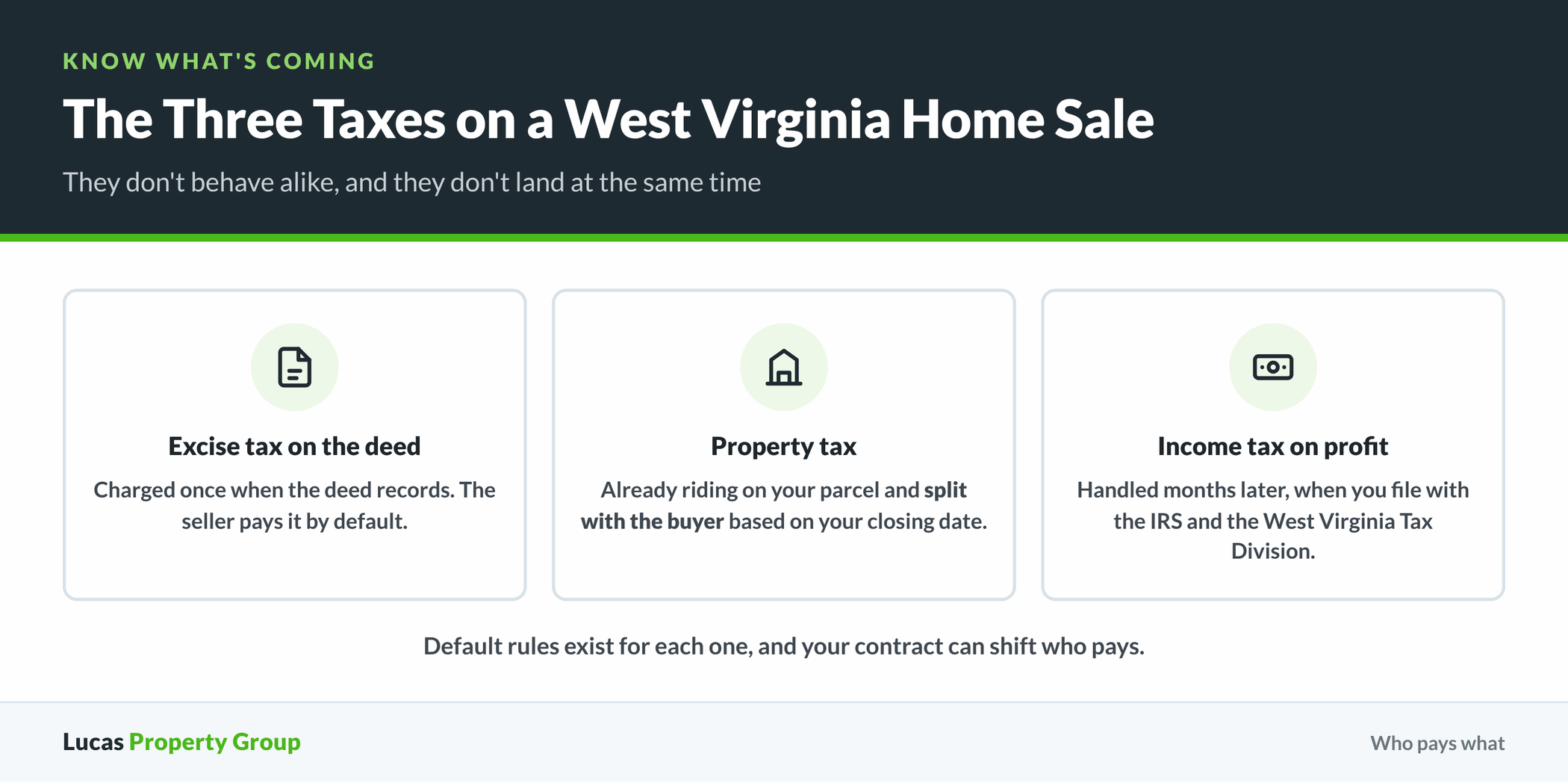
Your closing date sets that property tax split.
Quick test. Do you know, right now, what your county sheriff shows as outstanding on your parcel? Most sellers I meet guess within a few hundred dollars, and the guess tends to run low.
Timing the market matters here too, since every month you hold on adds property tax against you. As of September 2026, West Virginia homes were taking roughly 57 days to go from listing to contract, with a median sold price near $230,000 according to market data compiled from Realtor.com figures. For that whole stretch you’re still the taxpayer of record.
Figure out who pays taxes before you sign a listing agreement, not at the closing table. Every time.
Does the Buyer or Seller Pay Closing Taxes in West Virginia?
Early last year a retired couple in Elkins figured the buyer would split every charge with them, because that’s how it worked when they bought in the 1980s. Their settlement statement put the excise stamps squarely on their side. They still sold to us, but on that rainy Thursday they read every single line before signing anything.
Those line items weren’t unusual at all. A listed sale puts commissions, the excise tax, and a prorated property tax bill all on the seller side.
On the other side, buyers in West Virginia usually carry the lender’s charges: the appraisal, loan origination, prepaid interest and escrow deposits for taxes and insurance. That split matches how title professionals working both sides of the state line describe it, and sellers take the conveyance side.
I’ve written contracts where an eager buyer picked up the excise tax to win a bidding war in Morgantown. Other times sellers cover a buyer’s escrow setup just to keep a shaky sale alive.
So when someone asks me who pays taxes at a closing here, my answer is that default rules exist and negotiation overrides them.
My take differs from the usual advice. Haggling over the excise tax mostly wastes leverage, so put that negotiating capital toward the repair credit. On most homes here the excise runs a few hundred to a couple thousand dollars, and repair credits routinely come in at five times that.
Who Pays Transfer Taxes in a West Virginia Property Sale?
The excise tax deserves a closer look, because the state handles it differently than our neighbors across the Potomac do. You won’t see a “grantor’s tax” by that name. West Virginia charges an excise on the privilege of transferring real property instead, and the grantor is the default payer under the statute.
For every $500 of sale value, the state’s share runs $1.10. Counties can stack their own layer on top, which is why a Berkeley County deed and a Mingo County deed can cost different amounts to record at the same price. Statutory language in Chapter 11, Article 22 also adds a flat $20 fee to transfers for consideration, and that one stays the same no matter the price.
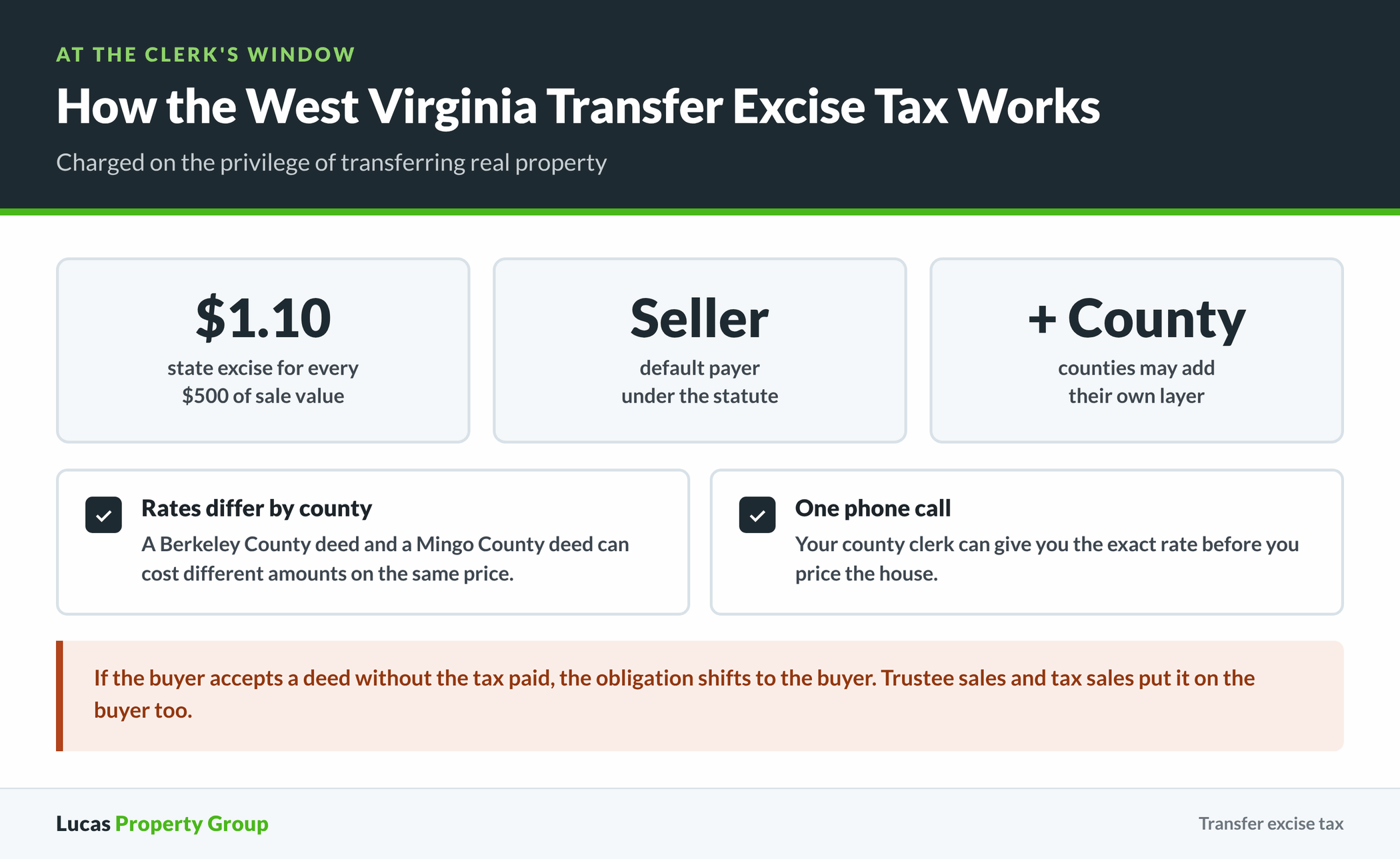
There’s one wrinkle. If the grantee accepts a deed before the tax gets paid, the obligation shifts to the grantee, and the person receiving the property ends up stuck with it. Transfers from a trustee, or from a county clerk conveying real estate sold for taxes, also put it on the grantee.
In practice, who pays taxes on the transfer? Nearly always the seller, collected at the clerk’s window when the deed records.
Your exact county rate is one phone call to the clerk away. I’d make that call before you price the house, not after.
What Taxes Do You Owe After Selling a West Virginia Home?
Closing day isn’t the finish line for your tax obligations. Treat it like one and you’ll find out otherwise in April.
Federal capital gains tax is the big piece. When your profit goes past what the IRS lets you exclude, you report the sale and pay at federal rates. Then the state taxes that same gain as ordinary income on your state return, since it has no separate preferential rate for long-term gains.
Those state brackets are graduated, five tiers running from 2.11 percent to a top rate of 4.58 percent for 2026, following the rate reduction signed in March 2026. Because your gain stacks on top of your wages, it can push you up a rung or two.
Nonresidents have an extra step. State law requires income tax withholding on real property sales when the seller is a nonresident individual or entity, so the state collects before anyone walks away from the table. Either 2.5 percent of the total payment or the top income tax rate applied to the estimated capital gain comes out before the deed is presented for recording, per TSD-389, revised April 2026.
Overpay, and you get the difference back.
Three forms run the process. There’s an application for a full or partial exemption, a return the closing agent files to send in the withholding, and an application for an early refund. Your exemption application has to reach the Tax Division no later than 21 days before closing, and missing that window means waiting on a refund instead of skipping the withholding altogether.
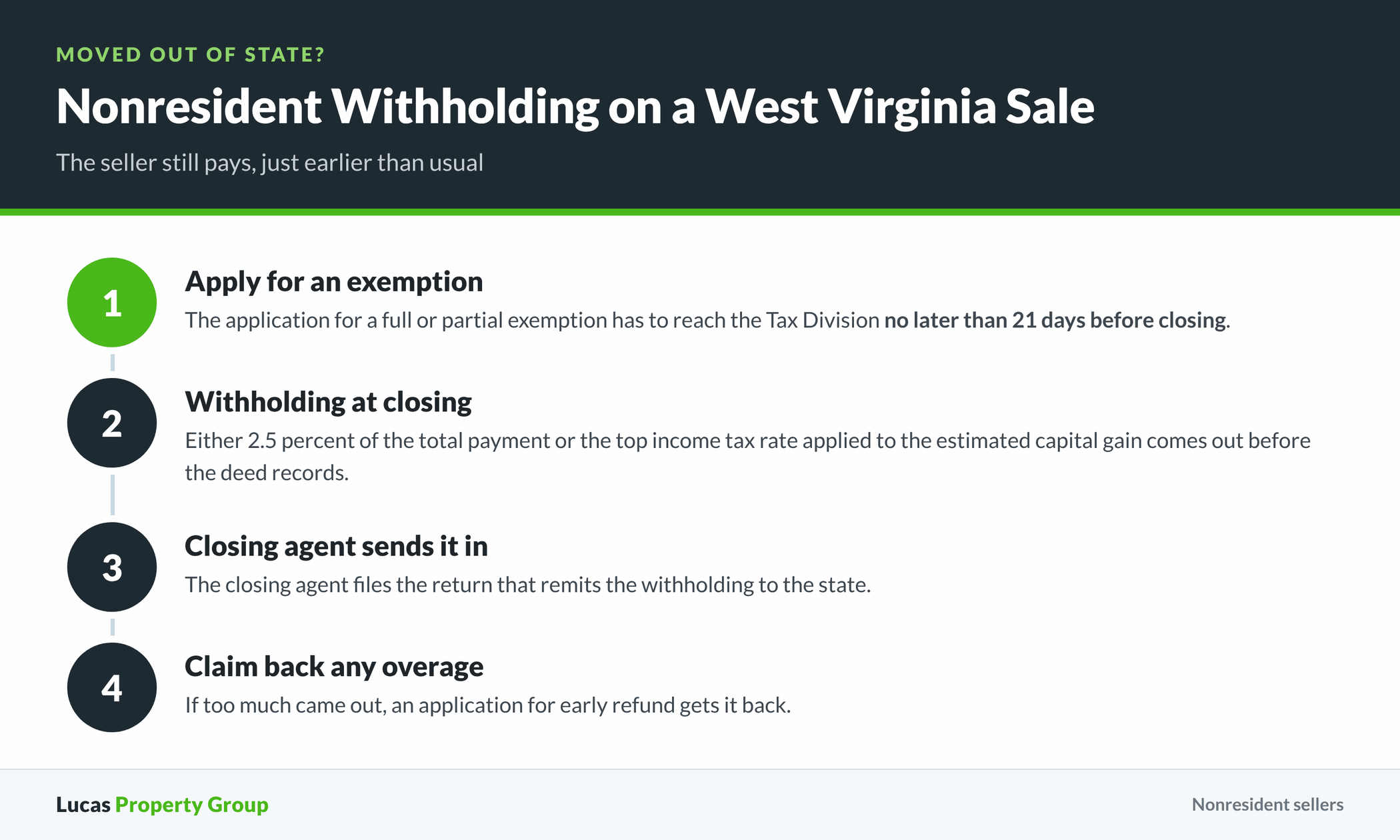
In the nonresident case, the answer to who pays taxes is still the seller, only sooner.
How Much Capital Gains Tax Will You Pay in West Virginia?
Plenty of sellers show up thinking the whole sale price counts as profit. It doesn’t. Your gain is the sale price minus the price you originally paid, minus the capital improvements you’ve made over the years, minus your selling costs.
Replaced the roof in 2014? That raises your basis. Commissions and the excise tax you paid at closing come off the top as well. I’ve watched families cut a projected gain nearly in half by digging old receipts out of a filing cabinet.
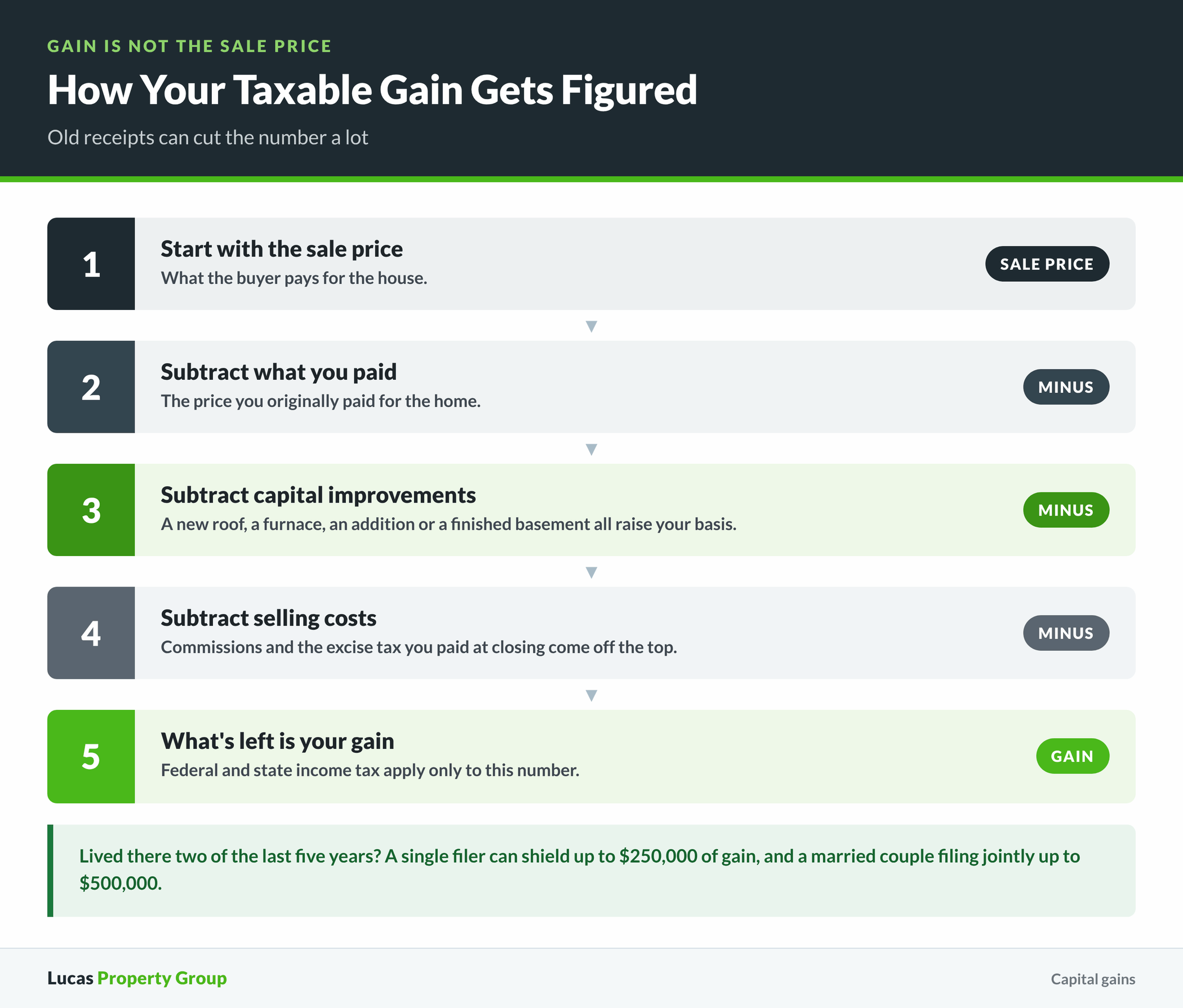
Biggest of all is the home sale exclusion, which starts with living in the house as your main residence for two of the last five years. Married couples filing jointly can shield up to $500,000 of gain. Single filers can shield up to $250,000. The IRS lays out the ownership and use tests in Topic 701.
Now hold that up against local prices. With the typical home here valued around $176,576 as of September 2026, according to Zillow’s home value index, very few owner-occupants blow past a quarter-million in gain. Where it does happen is long-held family homes in Jefferson County or along the Greenbrier corridor.
Landlords are another matter. Someone selling a Huntington duplex they’ve owned since the Clinton administration usually owes more than they planned for.
Federal long-term rates sit at zero, 15 or 20 percent depending on taxable income, and the West Virginia state tax lands on that same gain. You’re the one who pays taxes on the combined bill, and residents get no withholding safety net to catch it.
Do Inherited Homes Get Taxed Differently in West Virginia?
“My mother paid taxes on that house her whole life, so why would I owe anything?” I hear some version of that at kitchen tables all over the state. Mostly, the answer works in your favor.
West Virginia levies no inheritance tax and no estate tax. You don’t owe Charleston a dime just for receiving property from a parent.
It gets better. Inherited property gets a stepped-up basis, so your cost basis resets to fair market value on the date of death instead of whatever Mom paid in 1978. The IRS explains basis for inherited property in its guidance on property received from a decedent. If you sell within a year or two at close to that value, your taxable gain is frequently near zero.
Probate runs through the County Commission in West Virginia, not a circuit judge, and that trips up heirs who’ve handled estates in other states.
Keep an eye on the holding period. Property taxes pile up on an estate parcel, and so do insurance and utilities. Heirs spread across three states rarely agree fast, and the sheriff’s office won’t pause the bill while the siblings talk it over.
Who pays taxes on an inherited home before it sells? Estate funds cover it, right up until the deed changes hands. Plan for that if nobody’s living there.
Some families sorting out an inherited property would rather skip the repairs and showings, and a direct sale can be the cleaner route for them. Lucas Property Group works with heirs in exactly that spot.
Can You Avoid Paying Taxes on a Home Sale in West Virginia?
Two years. No other strategy on this list erases as much tax liability in West Virginia.
For an owner-occupant, meeting the IRS residence requirement before you sell is the cleanest path there is. Sellers in Charleston’s South Hills who are nine months short sometimes stay put until they cross the two-year mark instead of selling early, and the math usually backs them up.
Investors get a different lever. A 1031 exchange defers the gain on investment property when you roll the proceeds into a like-kind replacement. Nonresidents who use one still face the withholding rules unless they get that exemption certificate before closing.
Keeping track of improvements is boring, and it pays. Every receipt for a new furnace, an addition, or a finished basement raises basis and lowers the gain.
A loss on your personal residence gets you nothing deductible, which most people find unfair. Losses on investment property can offset other gains, though.
Statutes settle who pays taxes. Records and timing settle how much, and a good CPA earns the fee in one conversation before you list.
Just remember that carrying a vacant West Virginia house through a Mountain State winter can eat those savings fast.
What Happens If You Don’t Pay Taxes Owed on a Home Sale?
Signing the deed doesn’t make a delinquent property tax bill go away. It attaches to the parcel as a lien, and it stays your personal obligation too, so the title company will almost always pull it from your proceeds at closing.
County sheriffs collect property taxes in West Virginia, and unpaid amounts drift toward a tax sale through the state’s delinquent land system. Call your sheriff’s tax office for the current payoff and the exact schedule in your county. Mailing dates and payment steps vary locally, even though the statute behind them doesn’t.
Leave a reportable sale off your return and the IRS will match the closing agent’s filing against it.
One woman in Fairmont settling her father’s estate watched two agent listings expire back to back, not a single offer between them. The house had a wood stove in the living room and a garage packed to the rafters with his woodworking gear. By the time she called us on a Tuesday that fall, she’d carried two more tax cycles than planned, and the proceeds still covered the arrears with room to spare.
Ignore the question of who pays taxes left behind on a property and it ends badly for everyone. Clear them at closing.
Frequently Asked Questions About Who Pays Taxes When Selling a House in West Virginia
Do I Owe Taxes If I Sell My West Virginia House at a Loss?
No income tax is due without a gain. A loss on the home you live in isn’t deductible on your federal return, and with no gain the state has nothing to tax. Withholding can still be taken at closing from a nonresident seller, and you’d recover it by filing a return or through the early refund application covered earlier.
Is the Federal Capital Gains Rate 15 Percent or 20 Percent?
It might be either one, or zero. Your long-term rate depends on your total taxable income for the year, filing status included, so a retired couple and a two-income household selling identical homes can owe very different amounts. Short-term gains on property held a year or less get taxed as ordinary income instead. Your West Virginia return then taxes the same gain at the graduated rates described earlier.
Do I Have to Report the Sale If My Whole Gain Is Excluded?
Not always. When your entire gain fits under the exclusion and the closing agent doesn’t issue you a Form 1099-S, you generally don’t report the sale on your federal return. If that form does show up, report the sale even though no tax is due. The state return starts from your federal income, so an excluded gain stays out of your West Virginia income too.
Does the Buyer Ever Pay the Transfer Tax in West Virginia?
Sometimes. The statute puts the excise on the seller by default, but your contract can move it, and a buyer who accepts a deed without the tax paid becomes responsible for it. Trustee sales and tax sales put it on the buyer too, as described above. Go through the settlement statement line by line, since it shows exactly who pays taxes at closing.
Who Pays Taxes If the House Sells for Less Than the Mortgage?
A short sale changes things quite a bit. Property taxes still need clearing for the deed to transfer cleanly, and in practice the lender usually approves paying them from the proceeds because it wants the lien gone. Forgiven mortgage debt can count as taxable income in some cases, so talk with a tax professional before you agree to terms. Who pays taxes in that scenario depends heavily on how the lender writes the approval letter.
Can I Sell a House in West Virginia with a Tax Lien on It?
You can. The lien gets paid out of your proceeds at closing instead of quietly following you. Title companies search for exactly this, so a federal tax lien, a county delinquency or a judgment lien will all turn up. If the proceeds won’t cover everything, release and subordination processes exist, though they take time and paperwork. Starting early with your closing attorney keeps a sale from dying two days before settlement.
Does Selling to a Cash Buyer Change Who Pays Taxes?
Not the underlying obligations. A direct sale triggers the same excise tax on the deed, the same property tax proration and the same federal and state income tax treatment of any gain. The difference is timeline and cost, because you skip commissions and repair negotiations. Statute and your contract still decide who pays taxes either way.
Home Sale Taxes Around Morgantown
A lot of the sellers we hear from live in Monongalia County or the towns nearby. We buy houses in Morgantown in every kind of tax situation, from inherited homes to longtime rentals, and we buy houses in Clarksburg the same way.
The median sale price in Morgantown averaged about $306,600 in the first half of 2026, according to Redfin. At that price a long-held home can carry a real gain, so work out who pays taxes on it before you list.
Talk Through Your Home Sale Taxes With Us
If the tax side of a West Virginia sale has you stuck, I’m glad to walk through it with you. We’ve bought houses in just about every situation this state turns up: inherited, vacant, behind on the sheriff’s bill, or just plain tired. Reach out to Lucas Property Group whenever you’re ready. No pressure and no obligation, and if listing with an agent is the right call for you, I’ll say so.
You don’t need every tax form sorted before you call. Tell us where the house stands and what’s bugging you on the tax side, and we’ll lay out what listing and selling for cash would each leave you after closing. When you’re ready, reach out to Lucas Property Group and we’ll take it from there.
Helpful West Virginia Blog Articles
- How to Do Sale by Owner in West Virginia
- How to Sell a House with a Code Violation in West Virginia
- How to Sell a Probate House in West Virginia
- How to Sell a Hoarder House in West Virginia Without the Stress
- Who Pays Taxes When You Sell a House in West Virginia
- Can You Sell a House in Foreclosure in West Virginia
- How to Sell a House After Divorce in West Virginia