
A house doesn’t stop costing money when its owner passes away. Charleston mailboxes keep receiving the insurance bill, the Monongalia County tax ticket still comes due, and a vacant place in Wheeling still needs a furnace that works through February. That financial clock is why so many families start asking how to sell a probate house in West Virginia before they’ve even finished the funeral arrangements. I’ve bought houses across this state for years, and I want to walk you through what the process really looks like here.
What Is Probate in West Virginia?
Which judge do you stand in front of? None, as it turns out, because West Virginia has no separate probate court. Probate authority rests with the County Commission of the county where the person lived. Daily filings are handled by a Fiduciary Supervisor or Fiduciary Commissioner. So the office you walk into is the county clerk’s, not a courtroom.
The Uniform Probate Code hasn’t been adopted by the state, and it doesn’t split estates into “informal” and “formal” tracks the way many states do. One path, administered locally, with a staff person reviewing your filings instead of a judge issuing orders.
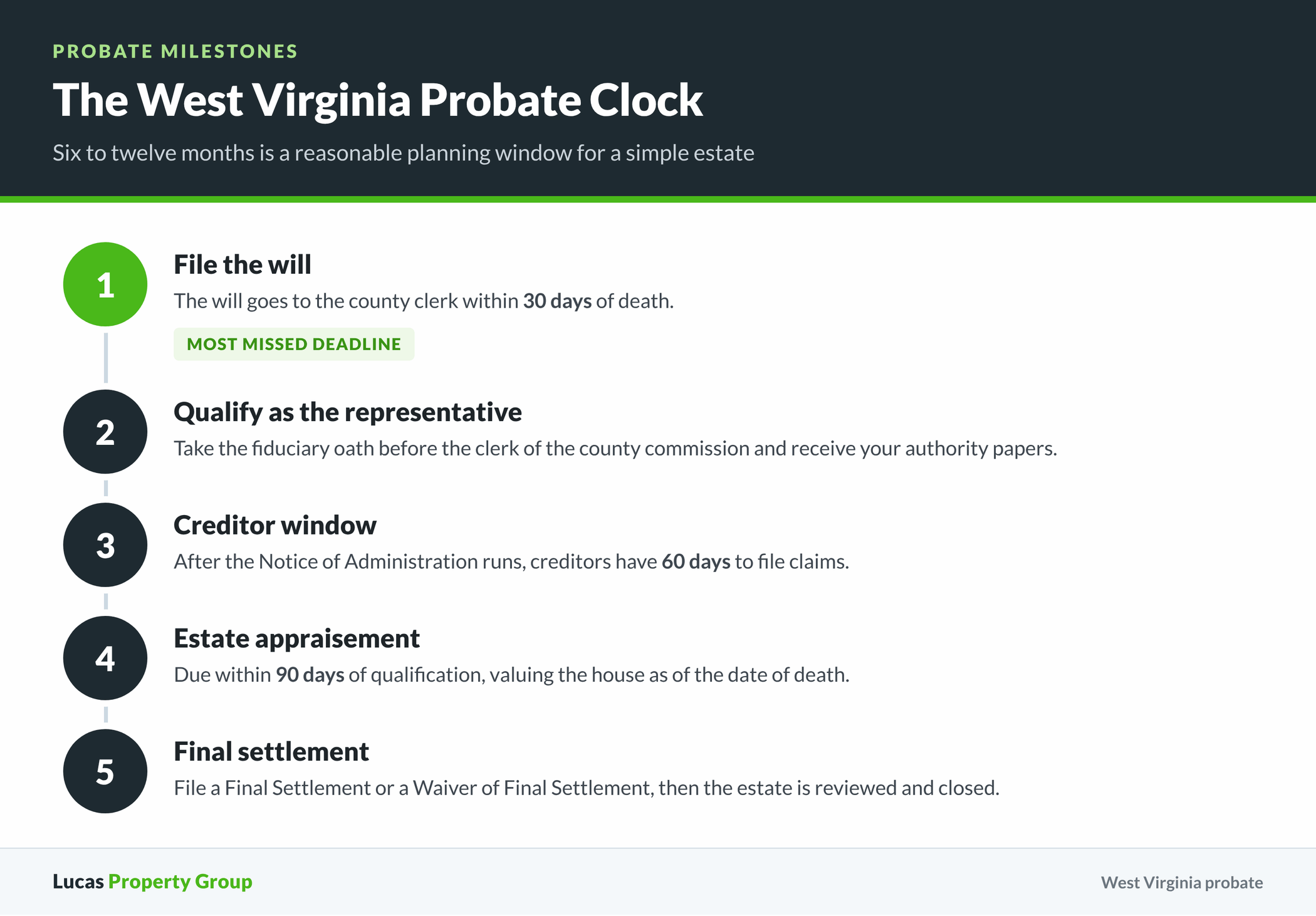
A probate house is simply real estate caught inside that sorting. Under state law, the will needs to go to the county clerk within 30 days of death. That one deadline catches more families than any other, because nobody’s thinking about filing paperwork during the first month.
Last year I bought a place in Elkins from a young couple who’d inherited her grandmother’s house after it sat full for three decades.
Creditors get their window too. The county clerk publishes a Notice of Administration, and creditors have 60 days to file their claims. Until that window closes and debts are settled, nobody’s distributing anything cleanly.
Can You Avoid Probate in West Virginia?
Families tell me the house will pass straight to the kids because that’s what the will says. Then the title company asks for letters of qualification, and the whole thing stalls at the closing table.
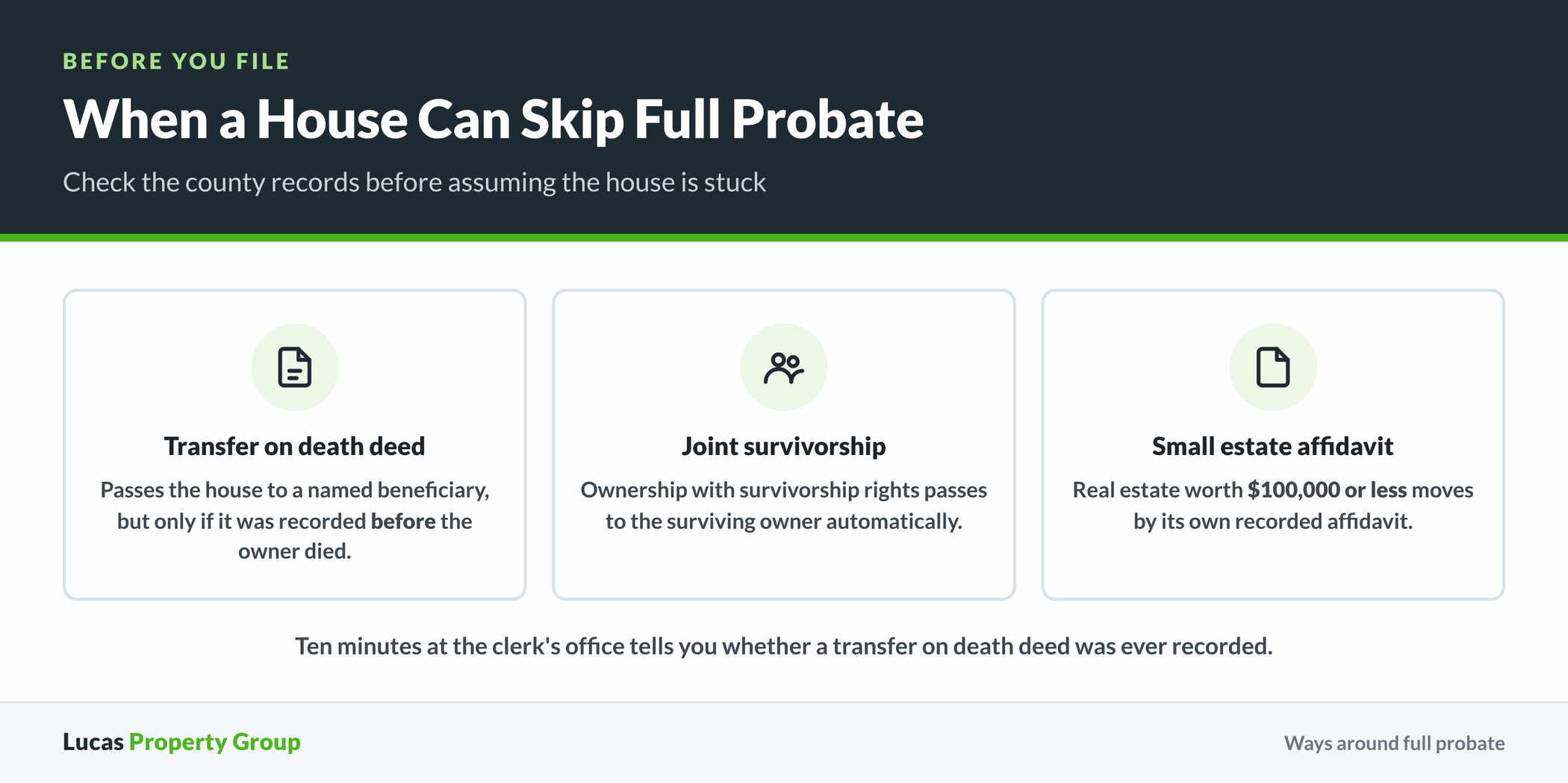
There are genuine ways around it, though. West Virginia adopted the Uniform Real Property Transfer on Death Act, so an owner can record a transfer on death deed that passes real estate to a named beneficiary at death, outside probate. The deed must meet the requirements of a recordable deed. It must state that the transfer happens at the owner’s death. Recording must happen before the owner dies, in the office of the Clerk of the County Commission where the land sits. It has to be recorded before death, not after, and no amount of family agreement fixes a missing one.
Joint ownership with survivorship rights does the same work automatically.
What about the small estate route everyone’s heard about? It’s narrower than people hope. Estates with $50,000 or less in personal property can bypass full administration through a small estate affidavit under the West Virginia Small Estate Act, but real property is excluded from that figure. Where a small estate includes West Virginia real estate valued at $100,000 or less, that real estate moves by a separate recorded affidavit under a different section of the same act. Your county clerk can tell you which form fits your situation and whether your county uses a fiduciary supervisor or a commissioner.
Selling a probate house is rarely about avoiding probate entirely. Have you checked whether a transfer on death deed was ever recorded on your parents’ property? Ten minutes at the clerk’s office answers that.
How Long Does Probate Take in West Virginia?
A family in Parkersburg called me in March thinking they’d be done by summer. They closed in late fall, after a creditor claim and a missing appraisement form ate four months.
The firm milestone worth planning around: the appraisement of the estate is due within 90 days of qualification, filed with the clerk of the county commission or the fiduciary supervisor. Stack the creditor period on top, add the final settlement review, and you’re looking at six to twelve months as a reasonable planning window for a straightforward estate.
Complications stretch it.
Meanwhile the market keeps moving without you. Realtor.com data for September 2026 put the typical West Virginia listing around $259,900 and the median sold price near $230,000, with homes spending about 57 days on market. Add the usual stretch from contract to closing, so a traditional listing becomes a months-long commitment on its own, layered on top of whatever probate is doing.
Families tend to forget to budget time for the closing step. After debts and taxes are settled, the executor files either a Final Settlement or a Waiver of Final Settlement, and a fiduciary commissioner or supervisor reviews and closes the estate.
I keep seeing the same mistake: families wait for probate to fully close before even thinking about selling the probate house.
Who Can Sell a Probate House in West Virginia?
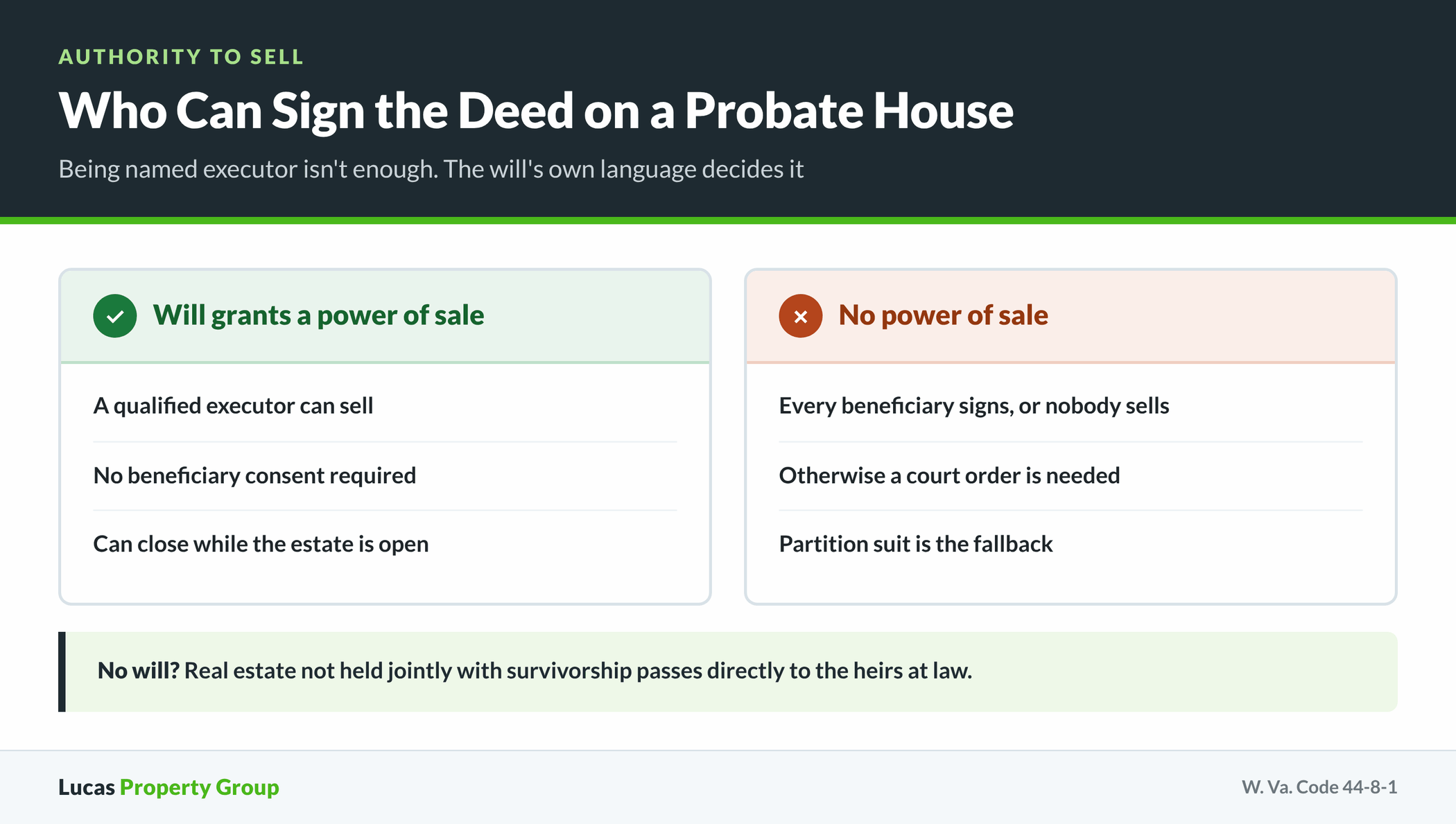
Being named executor in a will doesn’t give you authority to sell the house. West Virginia Code §44-8-1 covers an executor’s authority when real estate is devised to be sold or when the will gives the executor a power of sale.
When the will does grant that power, things move fast. A qualified executor empowered by the will to sell real estate not titled jointly with survivorship rights may do so without the beneficiaries’ consent. You can see the full statutory language through the West Virginia Code on Justia.
If the executor lacks power of sale under the will, only the beneficiaries have the right to sell or transfer the real estate, which means every heir signs, or nobody sells. Without that grant in the will, a sale generally needs heir consent or a court order. No one can be forced to sell their share outside a proper legal process like a partition suit.
Intestate estates follow their own path. With no will, real estate not held jointly with survivorship passes directly to the heirs at law under the West Virginia Code.
A probate house also stays exposed to what the deceased owed. West Virginia real estate remains answerable for the decedent’s debts.
Who in your family has actually read the will’s language on real estate? Not the summary from the attorney’s phone call, the paragraph itself.
How Do You Sell a Probate House in West Virginia?
With a power of sale in hand, or with every heir aligned, you can market and sell a probate house in West Virginia while administration is still open.
Qualifying comes first. The executor or eligible heir appears before the clerk of the county commission, takes the fiduciary oath, and receives the documents proving authority. Those papers give you full power and authority to act as the estate’s representative.
Next comes valuation. The estate appraisement establishes value at the date of death, and that figure matters for taxes later.
Then the practical layer: clearing out belongings, dealing with deferred maintenance, pricing honestly for condition. Pricing a 1940s Huntington bungalow against renovated comps is how probate houses sit unsold through two seasons.
Selling a probate house in West Virginia also means deciding how much work you want to do. Listing with a real estate agent means showings, inspections, repair negotiations, and a buyer whose financing can collapse in week six. Selling directly to a local investor means one walkthrough and a closing date you choose, and neither path is wrong. Lucas Property Group works with executors and heirs across the state and will tell you plainly when listing would net you more than selling direct.
Keep your paperwork tight throughout. Receipts, settlement statements, deeds, and the final accounting all pass under the fiduciary supervisor’s review before the estate closes.
What If the Probate House Has a Mortgage?
The loan survives the owner. Payments keep coming due monthly, and the estate has to cover them from estate funds, from an heir’s pocket, or from a sale.
Federal rules protect successors in interest, so an heir can usually get loan information and discuss options with the servicer without first assuming the debt. Call the servicer early, give them the death certificate and your qualification papers, and ask them to recognize you as a successor.
Reverse mortgages run a tighter clock than conventional loans, and heirs often lose the house by simply not responding to the servicer’s letters. If the deceased had one, call the servicer this week.
Equity is what makes the decision for you. Redfin put the West Virginia median sale price at $256,183 in August 2026, well below the national figure. So some probate houses carry thinner equity cushions once families add up payoffs, liens, and carrying costs. Run the numbers before you commit to holding the probate house through a long listing.
Two mortgages on the same estate, or a mortgage plus a home equity line, complicates the payoff math but doesn’t change the approach: get exact payoff figures in writing, then decide. I’ve seen heirs sit on this too long, and a probate house with little equity and a growing default is a candidate for a fast sale, not a patient one.
What If the Probate House Needs Repairs?
A seller in Fairmont inherited her uncle’s split-level with a roof that had been leaking into an upstairs bedroom for two winters. The plaster was gone, the subfloor was soft, and her contractor quoted a number that exceeded what she had in savings.
Older housing stock, a decade of deferred maintenance, and heirs who live out of state and can’t supervise a renovation from Columbus or Raleigh.
Financed buyers make it worse. An FHA or VA appraiser flags peeling paint, a bad roof, or missing handrails, and suddenly your sale depends on repairs the estate can’t legally pay for without the fiduciary supervisor’s blessing.
My opinion, formed over years of buying houses: renovating a probate house before selling is usually a losing bet for heirs. You’re spending estate money, coordinating trades remotely, carrying insurance and utilities for months, and the resale bump rarely covers all of it. Roofs, foundations, and full systems replacements, almost never.
Selling as-is shifts that risk to someone who prices for it. You’ll net less per square foot than a renovated comp, but you’ll also skip the contractor draws and the vacant-property insurance premiums. Vacant houses in West Virginia winters are their own category of risk, with frozen pipes turning a cosmetic problem into a gut job by March.
Have you gotten actual bids, or are you working from a guess? Two real estimates change the conversation fast.
What Are Your Options for Selling a Probate House?
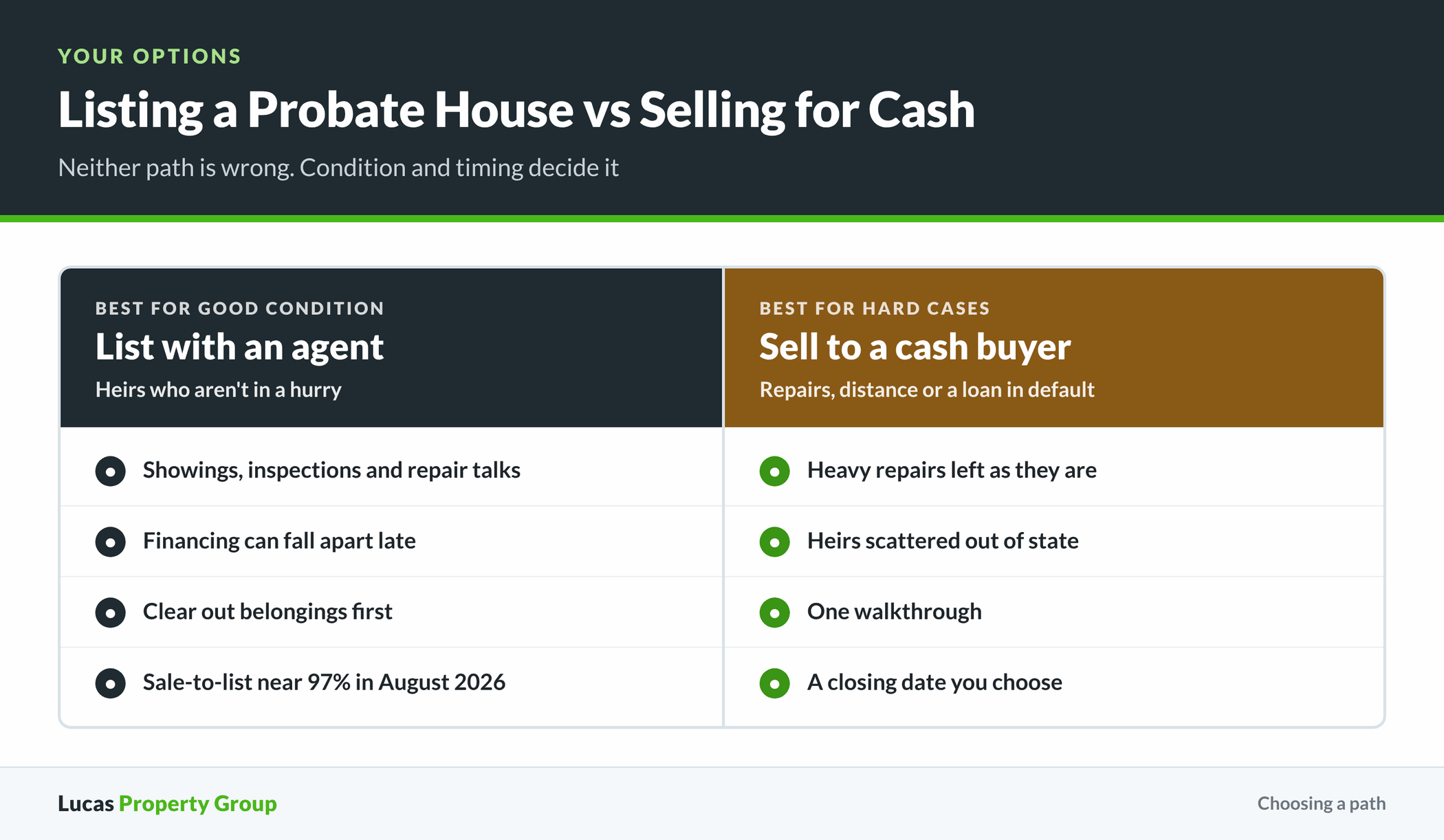
Listing with a real estate agent makes sense for a probate house in good condition with heirs who aren’t in a hurry. Sale-to-list ratios in West Virginia sat near 97% in August 2026, so well-presented homes have been getting close to asking. I’ve seen it play out with a tidy ranch in Morgantown near the university, where that wait usually pays.
Selling to a cash investor fits the other cases: heavy repairs, scattered heirs, a mortgage in default, or a probate house nobody can maintain from out of state. You trade some price for certainty and speed, and for a lot of estates that trade is worth making. Lucas Property Group buys in this condition range and can close around the estate’s timeline rather than a lender’s.
A third option gets overlooked: one heir buys out the others. If a sibling wants the family place and the rest want cash, a buyout through a refinance keeps the probate house in the family while avoiding commissions altogether. It only works when everyone agrees on value, which is why an independent appraisal earns its fee.
One seller I worked with in Martinsburg had been quietly covering her mother’s mortgage alongside her own for close to a year, never mentioning it to her brother because she didn’t want a fight. When we finally talked numbers, the carrying costs she’d absorbed had eaten most of what the extra months of waiting might have earned her.
Whatever route you pick, talk to an attorney who handles estate work in your county, and get your qualification papers before you negotiate anything. The West Virginia Legislature’s code site covers the statute, but your fiduciary supervisor knows how your particular county handles the paperwork.
Frequently Asked Questions
How Long Does It Take to Probate a Will in West Virginia?
Most uncomplicated estates here wrap up somewhere between six months and a year, assuming no one contests the will and the required filings go in on time. The appraisement deadline described earlier and the creditor claim window are the two gates that set the minimum pace. Estates with disputing heirs, out-of-state property, or fractional mineral interests regularly run past a year, so ask your county’s fiduciary supervisor what the current backlog looks like before you make plans.
What Happens If a Probate House Sells for More Than Its Appraised Estate Value?
Selling above the date-of-death valuation isn’t a problem; it just means the estate recognized a gain between death and closing. Because heirs receive a stepped-up basis at the date of death, the taxable gain is generally only the difference between that value and your net sale price. It isn’t the full appreciation since your parents bought the house in 1972. The extra proceeds flow into the estate and get distributed to beneficiaries along with everything else, and a CPA familiar with estate returns can confirm how it lands on your specific filing.
Who Actually Owns a Home During Probate?
With a will that includes a power of sale, the executor controls the property for administration purposes even though the beneficiaries hold the ultimate interest. Without a will, title passes to the heirs at law at the moment of death, so they’re the owners from day one even while the estate stays open. Either way, the property remains available to satisfy the deceased person’s debts until those are resolved, which is why title companies ask for estate documentation before they’ll insure a sale.
Can I Sell a Probate House in West Virginia Before the Estate Closes?
Yes, in most cases. If the will grants a power of sale, or if every heir signs the deed on an intestate property, you can close while the estate is still open. The one thing you can’t skip is qualifying with the clerk of the county commission first, because your buyer’s title company will want proof of your authority before funding.
Do All the Heirs Have to Agree to Sell a Probate House?
That depends entirely on the will’s language. An executor with an explicit power of sale doesn’t need unanimous consent, as described in the body above. When no such power exists, or when there’s no will at all, every person holding an interest signs or the sale doesn’t happen, and the fallback is a partition action in circuit court.
Is It Worth Cleaning Out a Probate House Before Selling?
Only if you’re listing it traditionally. Buyers using financing expect a presentable home, and a house packed with belongings photographs poorly and shows worse. If you’re selling to an investor who buys as-is, take the photographs, the documents, and the three things that matter to you, and leave the rest. Paying a crew to haul away furniture you’re not keeping rarely raises your net by more than the haul-away cost.
If you’re sitting on a probate house in West Virginia and you’re not sure which direction makes sense, we’re glad to talk it through. You might end up selling to us, listing with an agent, or holding onto it. Call when you’ve got time, ask whatever you need to ask, and nobody will push you toward a decision you’re not ready to make.
Probate Houses Around Morgantown
Most of the estates we see come from Monongalia County and the towns around it, and we buy from Morgantown homeowners whatever shape the house is in. Morgantown had about 525 active listings in the first half of 2026, up 11.5% from a year earlier, according to Redfin. More competing listings means a probate house that needs work has a harder time standing out, which is worth knowing before you pick a path.
Talk Through Your Probate House With Us
You don’t need your letters of qualification in hand to ask a question. Tell us where the estate stands and what shape the house is in, and we’ll lay out what listing and selling for cash would each look like for your family. When you’re ready, contact Lucas Property Group whenever it suits you. You can also tap the cash offer button at the top of this page.
Helpful West Virginia Blog Articles
- How to Do Sale by Owner in West Virginia
- How to Sell a House with a Code Violation in West Virginia
- How to Sell a Probate House in West Virginia
- How to Sell a Hoarder House in West Virginia Without the Stress
- Who Pays Taxes When You Sell a House in West Virginia
- Can You Sell a House in Foreclosure in West Virginia
- How to Sell a House After Divorce in West Virginia