
Two signatures on one deed, and two people who’d rather not share a room. I walk into that situation more than any other. Selling a house after divorce in West Virginia isn’t really a real estate problem. It’s a decision problem dressed up as one. The law here is more straightforward than it looks from the outside, and the market gives you some room to breathe. Let’s go through how it works, what it costs, and where sellers tend to get stuck.
Who Gets the House in a West Virginia Divorce Settlement?
If you built it together, you’ll probably split it together. West Virginia law tells the family court to divide marital property equally between spouses, and the court can move legal title to the former marital home when a fair outcome calls for it. You can read the transfer provision on the Legislature’s code site: West Virginia Code §48-7-105.
Courts can shift off that 50/50 starting point. The statutory factors include each spouse’s monetary and non-monetary contributions to buying or keeping up the property, along with any conduct that wasted or depreciated assets.
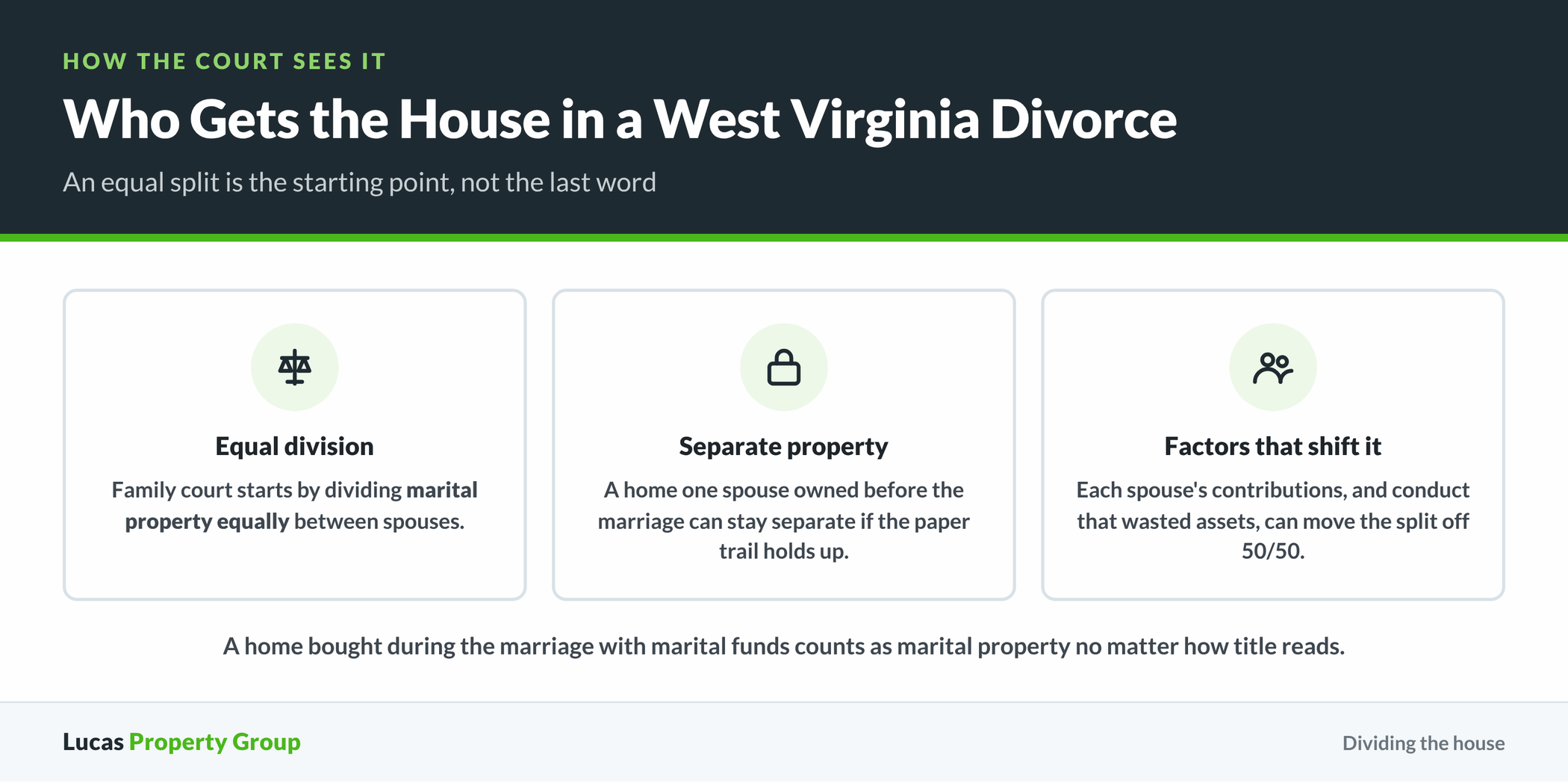
Separate property is where the real fights happen. A home one spouse owned before the wedding can stay separate if the paper trail holds. Refinance it with joint income, put marital money into a new roof or add the other spouse to the deed, and that line blurs quickly. Timing matters for the math too, since marital property is valued as of the date of separation, or a later date if the court finds that fairer.
Any home bought during the marriage with marital funds counts as marital property, whatever the title says.
Kids change the shape of things without touching the ownership math. A court may let the custodial parent stay in the home for a while, which can push the sale of the house after divorce out until a child finishes school. Meanwhile the other spouse still owns half, and that gets settled when the place sells or one of you buys the other out.
Years back I bought a brick ranch in Bridgeport from a couple halfway through their divorce. They agreed on exactly one thing, which was that neither of them wanted to keep it. She’d already moved out and he was sleeping in the finished basement, so we closed on a Saturday with wired funds and each of them signed at a separate table.
Can a Judge Force the Sale of a House During a West Virginia Divorce?
Plenty of spouses walk into mediation thinking they can just refuse. Sign nothing, agree to nothing, and the house stays frozen until the other side caves. It falls apart at the courthouse door. West Virginia family courts can order a sale of specific property and divide the net proceeds, whether by private sale, through an agent or by judicial sale. Whichever route gets the property sold in a reasonable time at a fair price is the one the court picks. You’ll find the full article text on the West Virginia Legislature’s code site.
Speed and a fair price. Not punishment.
Judges in West Virginia don’t enjoy ordering sales, and I think that reluctance is healthy. Most would much rather sign off on an agreement the two of you wrote, so mediation settles the house after divorce far more often than a ruling does.
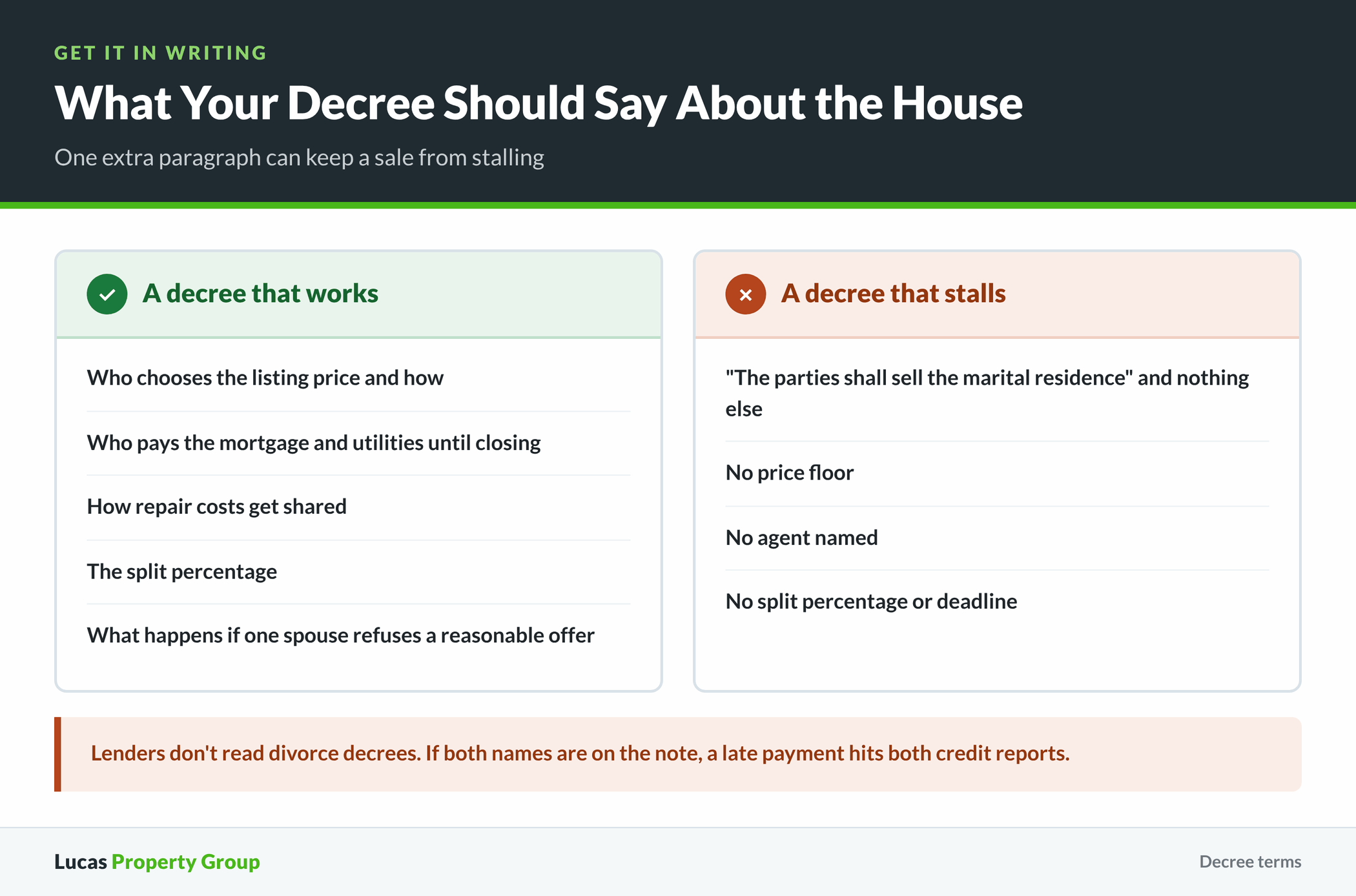
The ugly part is usually the stretch in between. One spouse stays in the house, quits paying the mortgage and lets the lawn grow. Both names are on the note, so the other spouse’s credit takes the hit anyway. Have you thought about what happens to the loan if payments slip while the case drags on? Lenders don’t read divorce decrees. Your decree can say the ex owns the mortgage, and the bank will still report the late payment on you.
Temporary orders exist for exactly this. Either side can ask the court to set who pays what during the case, mortgage, taxes and insurance included.
When a forced sale is the worry, the better move is usually getting ahead of it, since agreeing on a sale method yourselves keeps you in control of price, timing, and condition.
Should You Sell the House Before or After the Divorce Is Final?
“Why would I sell now? Prices are only going up.” I hear that a lot, and the data doesn’t back treating it as a sure thing. Statewide forecasting as of September 2026 has prices holding flat or rising roughly 1 to 3 percent over the next year, per a statewide market analysis. Sales volume is expected to stay thin but steady. Waiting a year to catch a couple of points, paying a mortgage you both resent the whole time, rarely comes out ahead.
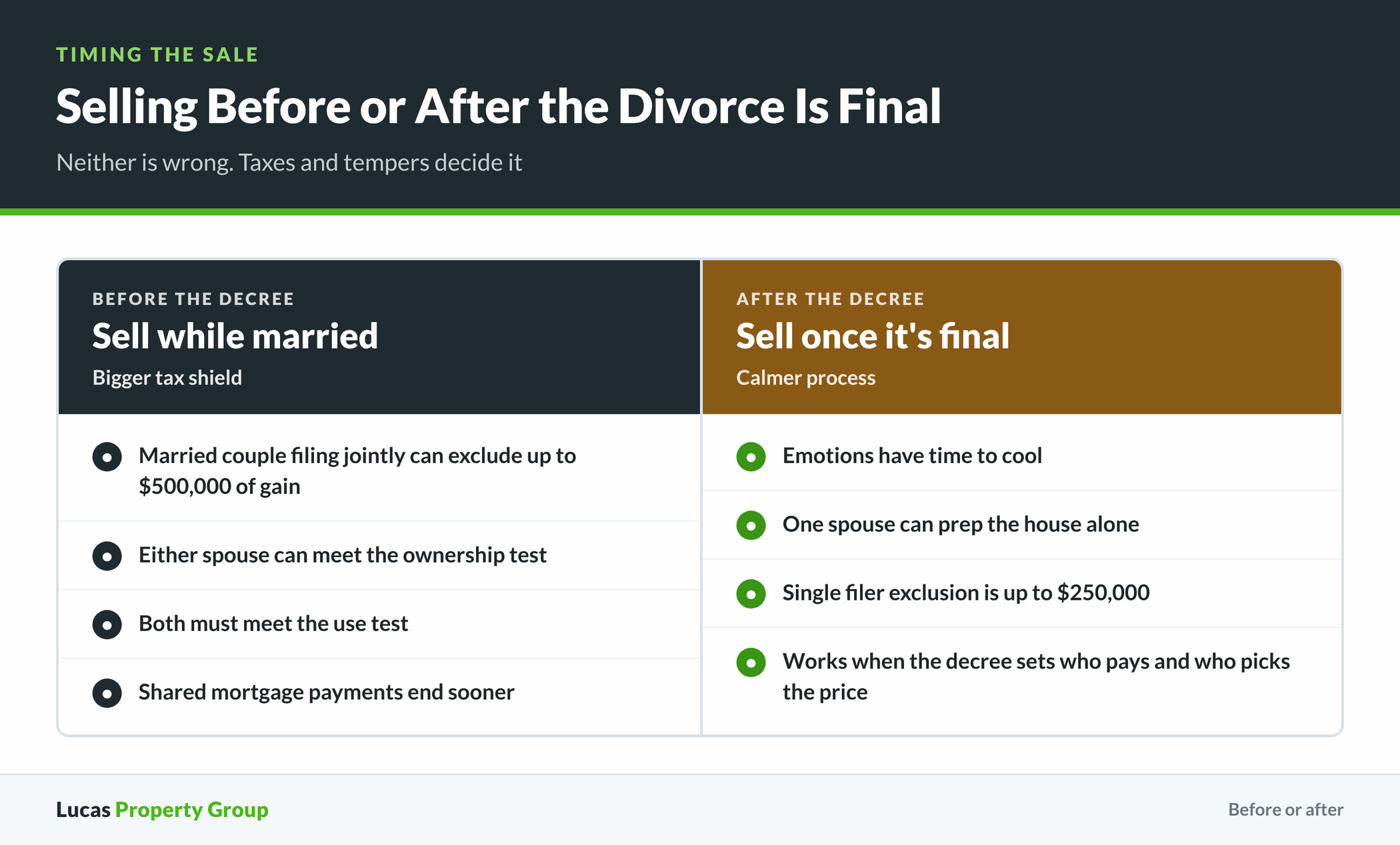
Selling before the decree can protect the federal capital gains exclusion. The spouse who moves out can fail the use test if the house sits too long. When you file jointly, either spouse can satisfy the ownership test, but both must individually meet the use test. Married couples filing jointly can exclude up to $500,000 of gain, compared with $250,000 for a single filer, once the ownership, residence and look-back tests are met. The IRS lays it out in Topic 701.
Most West Virginia homeowners won’t get close to those ceilings. It mainly matters for long-held homes in the Eastern Panhandle, or lake places that appreciated hard. Check with your CPA before you write it off, because the answer turns on your basis, not your gut.
Selling the house after divorce has its own logic. Tempers cool off. Once one spouse relocates, the other can get the place ready without arguing about paint colors through two lawyers. Co-owning after a decree works when things are civil and the decree spells out who pays what, who sets the price and what happens if you deadlock.
Picture two owners, no tiebreaker and a $7,000 roof quote nobody wants to pay. Put a decision rule in the agreement before you need one.
What Financial Issues Affect Dividing a House After Divorce?
Your equity isn’t your sale price minus your mortgage balance. Closing costs, the per-diem interest on the payoff statement, any unpaid property taxes and repair credits all come out first, and splitting a phantom number makes for a nasty surprise at the settlement table.
Commission is the biggest line on a listing, and it comes right off the number you two are about to split. Add title work and transfer fees, and a real slice of the proceeds is gone before either of you sees a dollar.
Buyouts only work if the spouse who stays can qualify alone, and lenders underwrite that person at today’s rates. Here lies the other trap: one income, one debt-to-income ratio and a rate well above whatever you locked years ago. I’ve seen more buyout plans die at underwriting than at the negotiating table, usually about three weeks after both sides already agreed.
West Virginia courts split marital debt by the same equitable distribution principles they use for property. A HELOC taken out during the marriage doesn’t vanish just because one spouse spent the money.
Houses stuck in divorce limbo stop getting fixed. Gutters, furnaces, water heaters, none of it gets attention when nobody wants to invest in something they’ll lose half of. Two years of that kind of neglect can cost more than the whole fight was worth.
One more item on the house after divorce is income tax on any gain past the exclusion, plus who claims the mortgage interest for the year of sale. Settle that in writing.
What Are the Alternatives to Selling a Marital Home After Divorce?
Some owners really don’t want to sell, and that’s a fair position. A buyout is the cleanest alternative: one spouse refinances into their own name and pays the other their share of the equity. Clean title and a clean break, as long as the qualifying math works.
Deferring the sale of the house after divorce is option two. You both stay on as owners, one of you lives there, and you agree on a future trigger like a child’s graduation, a job change or a fixed date. Vague triggers produce second lawsuits.
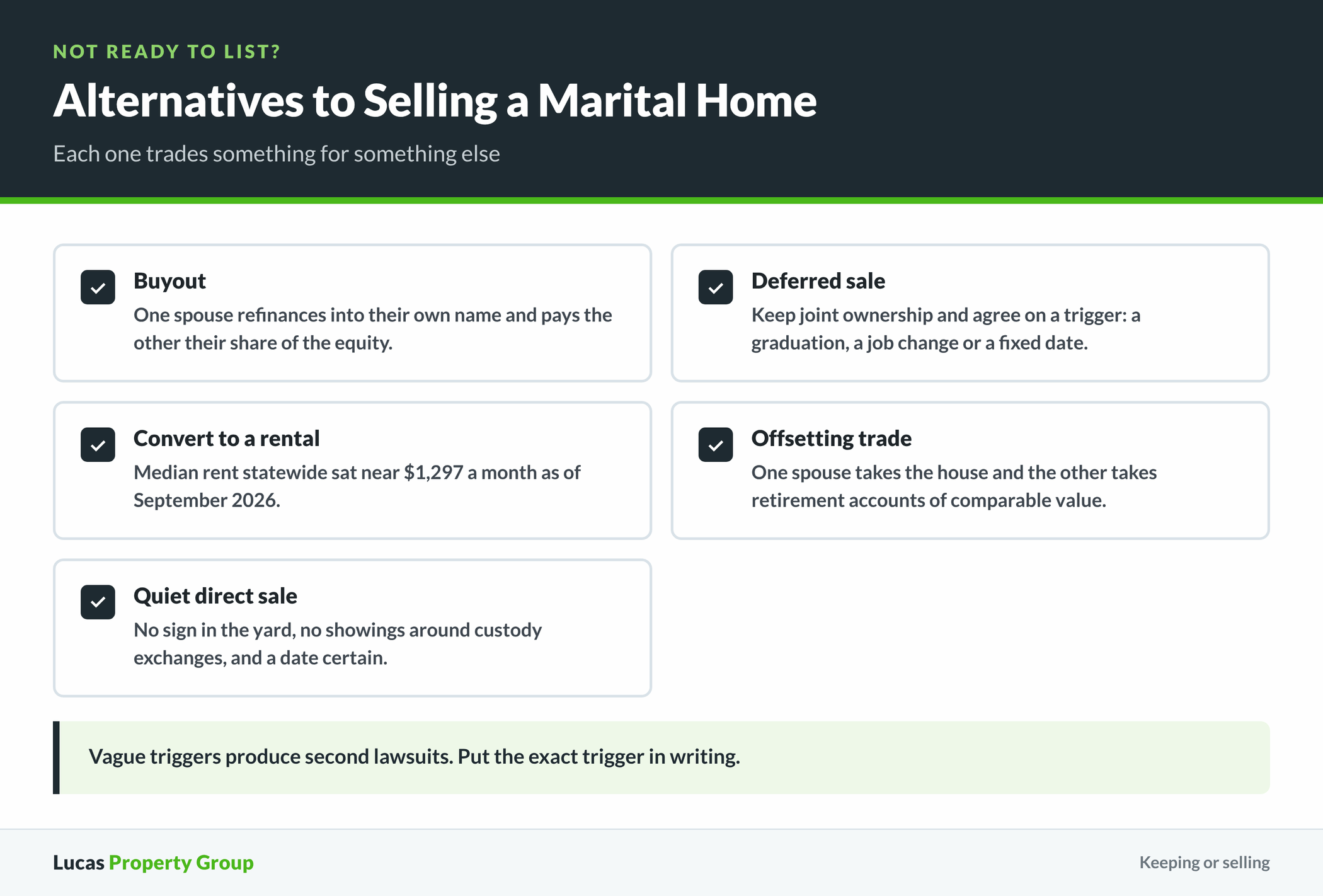
Turning the place into a rental is underrated in West Virginia, and I say that as someone who buys houses rather than managing them. Median rent statewide sat near $1,297 a month as of September 2026, up about 8.1 percent from a year earlier. Around Morgantown, student demand keeps units near campus full. Martinsburg and Charles Town draw commuters heading west out of the D.C. corridor. With a cheap mortgage and a sound roof, holding can beat selling.
Just know that a rental with your ex is still a business partnership with your ex.
Other families keep the property and restructure around it. One spouse takes the house and the other takes retirement accounts worth about the same. Such a trade looks great on paper and falls apart in practice when the house needs $40,000 in work and the 401(k) doesn’t.
Somewhere between keeping and listing sits a quiet off-market sale. No yard sign, no neighbors touring your living room and no showings scheduled around custody exchanges. We handle this regularly at Lucas Property Group for divorcing couples who want privacy and a date certain. It won’t fit every property, but it solves a problem a traditional listing can’t.
How Does Selling a House After Divorce Work in West Virginia?
Any sale during or after a split starts with paperwork.
Your title company will ask for the recorded deed, the divorce decree if there is one, and any order covering the property. If the decree gives the house to one spouse but the deed still shows both, you’ll need a corrective deed recorded before closing. Your county clerk’s office records it and can walk you through its current fees and requirements.
After that come the market mechanics. West Virginia homes listed traditionally spent a median of 57 days on the market as of September 2026, per Realtor.com figures, and closing takes several more weeks after that. Can the two of you hold it together that long?
Pricing fights are normal here. One spouse wants top dollar and has endless patience, and the other wants out by spring. Agree up front on an appraisal or an average of two agents’ numbers, and agree on a price-reduction schedule in writing before you list.
Write the split of the proceeds into that same document. Title companies won’t make up that allocation for you, and they shouldn’t.
A direct sale shortens the whole sequence. There are no showings, no repair negotiations and no financing contingency falling apart on day 38. Selling to a cash buyer in West Virginia can cut the timeline to as little as seven days. You’ll net less than a perfectly run retail sale, and for some divorcing couples that tradeoff is clearly worth it. Others will feel differently, so run both numbers before you decide.
Do You Need a Lawyer for Selling a House After Divorce in West Virginia?
A seller called me three days before closing once, because her decree said “the parties shall sell the marital residence” and not a word more. It named no price floor, no agent, no split percentage and no deadline. Her ex had already turned down two offers.
One extra paragraph from a family law attorney would have headed off all of it.
Real estate attorneys and title agents handle the conveyance, and family law attorneys handle the division. Those are different jobs, and you may need both. Uncontested West Virginia divorces commonly run $1,500 to $3,000 total, and contested ones climb to $15,000 to $50,000 or more. Paying a few hundred for precise language about the house after divorce is cheap insurance against ending up in that second group.
Your decree should pin down who picks the listing price and how, plus who covers the mortgage and utilities until closing. It should also say how repair costs get shared, what the split percentage is and what happens if one spouse refuses a reasonable offer.
You won’t need an attorney for every step. When you’ve agreed on everything and the decree is clear, a title company can usually handle it from there. Stonewalling by one spouse changes that, and so does separate property tangled up in the home’s value. Either one is lawyer territory. Before anyone files motions, ask about mediation through the family court system, since it’s a solid middle path.
One woman in Fairmont called me after her decree awarded her the house, but her ex was still on the deed and had stopped answering his phone. The place had a sunroom off the kitchen she never got around to painting. Once her attorney sorted out the title, we closed on a Wednesday, and she kept the porch swing.
That’s a pretty common shape: a house after divorce with loose ends in the paperwork, and nobody with the energy for a traditional sale. We see that mix regularly, and one straightforward conversation usually makes it clear whether a direct sale or a listing suits you better.
Frequently Asked Questions About Selling a House After Divorce in West Virginia
Do Both Spouses Have to Be at the Closing in West Virginia?
Not in the same room, and not necessarily on the same day. Every owner on title has to sign off on selling the house after divorce. Most title companies can arrange separate signing appointments, or a mail-away closing for an owner who’s left the state. Ask the closing agent early what they offer, because each signature needs a notary and the logistics take time.
Who Pays the Mortgage While the House Is Listed in West Virginia?
Whoever your temporary order or written agreement names. If nothing names anyone, you’re both on the hook, since both names sit on the note and the lender reports a late payment against each of you. Get the mortgage, taxes, insurance and utilities in writing before the listing goes live, so a slow market doesn’t become a credit problem for either of you.
Can We Sell the House Before Either of Us Files for Divorce?
Yes. If you’re both on the deed and you both agree, you can sell before anyone files. That keeps the larger joint exclusion on the table while you both still meet the use test. Write down how you’ll split the proceeds before closing, because a title company won’t decide that for you. Talk to a family law attorney first if you think the split could turn into a fight later.
How Are Finances Typically Divided in a West Virginia Divorce?
Courts start from an even split of everything acquired during the marriage, including the home, retirement contributions earned in those years and the debts tied to both. Separate property stays with its original owner if you can trace and document it. Courts can move away from an even split based on what each spouse contributed and whether either one drained assets. The house after divorce usually gets handled through a buyout, a sale with the proceeds divided, or an offsetting trade against other assets.
Can One Spouse Sell the House Without the Other Agreeing?
Not on their own, if both names are on the deed. A title company will want both signatures or a court order directing the sale. If your spouse won’t cooperate, your attorney can ask the family court to order the property sold and the proceeds divided, and West Virginia judges have clear statutory authority to do that. Reaching an agreement first is almost always faster and cheaper.
How Fast Can I Sell a House After Divorce in West Virginia?
It depends on the path you take. A traditional listing with showings, inspections and buyer financing takes months from the day you sign the listing agreement. Selling direct for cash can wrap up in a week or two, with no appraisal contingency and no lender timeline. In most divorce sales the real bottleneck isn’t the market at all, it’s how long two people take to agree on a plan.
Divorce Sales Around Morgantown
A lot of the couples we talk with live in Monongalia County or close by. We buy houses in Morgantown and the towns near it in whatever condition the split leaves them.
In May 2026, more than a third of Morgantown’s listings were still unsold after 60 days, according to Redfin. That’s a long time for two people to share a mortgage on a house after divorce.
Talk Through Your Divorce Sale With Us
If you’re sorting out a house after divorce and just want someone to tell you plainly what your options look like, we’re glad to walk through it with you. No pitch, no pressure, and no hard feelings if a listing turns out to be the better move. Reach out whenever you’re ready to talk it over.
You don’t need a final decree in hand to ask a question. Tell us where the case stands and whose names are on the deed, and we’ll lay out what listing and a direct sale would each look like for both of you. When you’re ready, contact Lucas Property Group and we’ll take it from there.
Helpful West Virginia Blog Articles
- How to Do Sale by Owner in West Virginia
- How to Sell a House with a Code Violation in West Virginia
- How to Sell a Probate House in West Virginia
- How to Sell a Hoarder House in West Virginia Without the Stress
- Who Pays Taxes When You Sell a House in West Virginia
- Can You Sell a House in Foreclosure in West Virginia
- How to Sell a House After Divorce in West Virginia