
Foreclosure in West Virginia moves faster than a normal home sale, and the clock usually starts before a seller is ready. An uncontested non-judicial foreclosure here often wraps up in roughly two to three months, less time than the average listing needs to find a buyer and close. The math explains why so many sellers call me after the notice of sale lands, not before. A house in foreclosure is still your house, and you still hold the right to sell it. What shrinks every week you wait is the number of ways you can do that without losing control.
What Happens to Your House in Foreclosure If You Do Nothing?
“The bank doesn’t really want my house, so they’ll work with me.” I hear that a lot, and it holds a sliver of truth. Servicers prefer a performing loan over a trustee’s sale. Preference isn’t protection, though, and the file keeps moving whether or not anyone calls you back.
In West Virginia the process starts out of court. You get two notices before losing the home: first a notice of default from the lender, then a notice of sale. The trustee publishes it as a Class II legal advertisement, which runs in a county newspaper once a week for two successive weeks. Beyond the newspaper, the trustee mails you a copy by certified mail, return receipt requested. Any junior lienholder who has registered its lien gets one at least twenty days before the sale. Anyone can read a newspaper notice, so investors read it, neighbors read it, and your phone starts ringing.
Letting the sale happen doesn’t always end the debt either. West Virginia has no anti-deficiency law, so deficiency judgments are permitted. After a nonjudicial foreclosure, the lender has to file a separate lawsuit against the borrower to pursue one. You can lose the house and still face a claim for the shortfall afterward.
Surplus funds rarely get the attention they deserve. When the sale brings in more than the sale costs and the secured debts, you may be owed that surplus. Auctions seldom produce one, though, because the lender usually bids the debt and walks away with the keys.
Doing nothing is a decision. It’s just a decision made by other people, on their calendar.
Can You Sell a House in Foreclosure in West Virginia?
Yes, and your right to sell survives right up until the gavel falls. State law gives you ten days to cure the default after the lender’s notice, though that right runs out once you’ve defaulted three times. Many deeds of trust also let you reinstate by catching up any time before the sale. Selling works on the same clock. Close before the trustee’s sale and the mortgage gets paid from your proceeds; the foreclosure simply stops.
A sale date on a house in foreclosure isn’t always final, either. Sometimes the trustee postpones it, and a real contract sitting on a servicer’s desk can help earn that delay. It isn’t automatic and nobody can promise it. Still, I’ve seen a signed sales contract with proof of funds carry weight that a phone call never will.
What you can’t do is sell for less than the payoff without the lender agreeing. That’s a short sale, and it’s a negotiation, not a right.
Last year a family in Weirton called me about their mother’s house after she’d moved in with a daughter. The payments slipped three months behind while everyone debated what to do. So they sold it as-is and kept the surplus after the loan was paid off.
Plenty of homeowners in West Virginia can still sell at a profit, because equity built quietly while they worried about payments. Statewide in September 2026, the median sold price sat near $230,000, up about half a percent year over year. Owners who bought six or eight years ago may have a payoff well under that. For them, a house in foreclosure with real equity is a solvable problem. A HUD-approved housing counselor can confirm where your loan stands before you commit to anything.
How Does Foreclosure Affect Your House Sale Timeline?
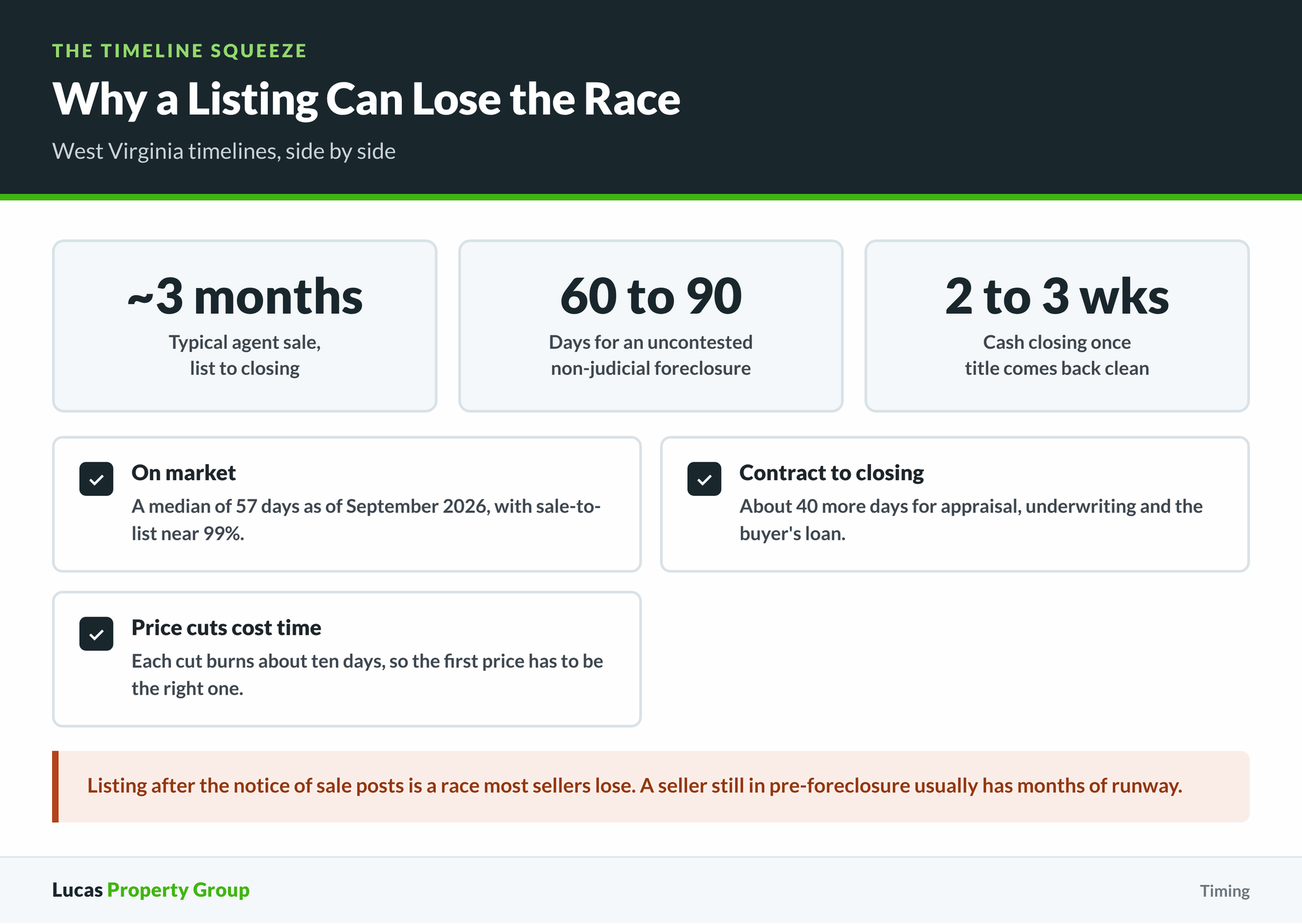
West Virginia listings spent a median of 57 days on market as of September 2026, with sale-to-list prices running near 99%. Then there’s the escrow period to factor in. Add roughly 40 more days from contract to closing, and a typical agent sale here runs about three months end to end.
Set that next to the foreclosure clock described above, and the squeeze is obvious. Even a seller who signs with an agent the day the notice arrives is starting from behind. Listing traditionally after the notice of sale posts is a race you’ll probably lose.
Does that mean an agent is the wrong call? Not always. A homeowner still in pre-foreclosure, and only a payment or two behind, likely has months of runway. An open market sale will pay that seller more, so the time is worth using.
Timing changes by market, too. Morgantown moves differently than McDowell County, and the Eastern Panhandle counties near Martinsburg draw commuters from Maryland and Virginia. Houses there turn faster than they do in the southern coalfields. Your personal timeline depends on which part of the state you’re selling in.
The mistake I see most: sellers price for the market they wish they had, then cut twice in six weeks. Each cut burns ten days they didn’t have, so there’s no room left for trial and error. Any house in foreclosure that must sell by a hard date needs the right price the first time.
Buyers who need financing bring their own delay. Appraisals, underwriting conditions and a last-minute credit pull can push a closing past the sale date even when everyone means well. Even a few days’ grace rarely saves it. Cash removes those links from the chain, which is why investors like our team at Lucas Property Group can commit to a date and hold it.
What to Gather Before You Sell a House in Foreclosure in West Virginia
Guessing at your payoff is the single most expensive habit a distressed seller has.
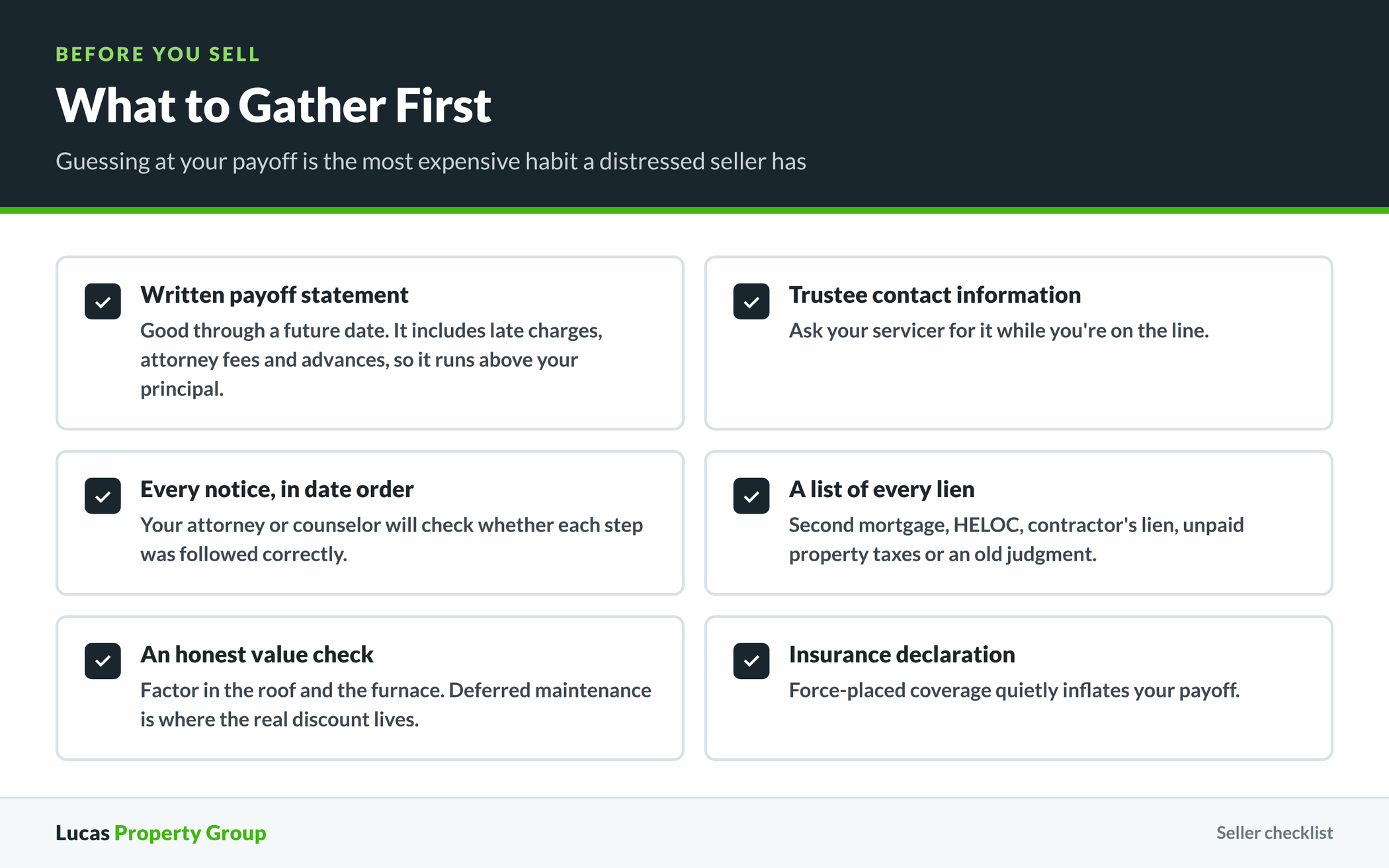
Call your servicer and request a written payoff statement good through a future date. That figure includes late charges, attorney fees, and advances for taxes or insurance, so it’s almost always higher than your remaining principal. Ask for the trustee’s contact information while you’re on the line.
Pull every notice you’ve received and put them in date order. The notice of default matters because the state’s process runs on a notice schedule. Your attorney or counselor will want to see whether each step was followed correctly. Keep the envelopes too, since mailing dates can matter.
Then there are the liens nobody remembers until title work turns them up: a second mortgage, a HELOC from a remodel, or a contractor’s lien. Title searches also surface unpaid property taxes and old judgments from medical bills. After a trustee’s sale, the sale costs and the debts secured against the house get paid before any surplus reaches the former owner. Knowing what sits behind the first mortgage tells you whether a sale nets you anything.
Your county clerk’s office can confirm what’s recorded against the house. Fees and procedures differ from one courthouse to the next, so call ahead rather than driving to Charleston or Clarksburg on a hunch.
Have you looked at what the house would appraise for today, realistically, with the roof and the furnace factored in? Homes in good shape here sell close to their asking price, so the gap between asking and getting is thin. Deferred maintenance is where the real discount lives.
One more document: your most recent homeowner’s insurance declaration. Lenders force-place coverage on a house in foreclosure when a policy lapses, and that premium quietly inflates your payoff.
What Other Ways Exist to Sell a House in Foreclosure in West Virginia?
A seller in Parkersburg once told me he’d rather give the house back than take a dollar less than list. Four weeks later he took the cash offer. A deed in lieu would have left the deficiency question wide open.
Short sales come first for anyone underwater. The lender agrees to release the lien for less than the balance, and the negotiation runs on the servicer’s schedule, not yours. You can also negotiate a deficiency waiver as part of a short sale approval in West Virginia. That waiver is the whole reason to attempt one. Never sign a short sale approval letter without reading what it says about the remaining balance.
Deeds in lieu look simpler and often aren’t. West Virginia has no law preventing a lender from pursuing a deficiency judgment after a deed in lieu. Handing back the keys without a written release can leave you exposed.
Selling direct to a cash buyer is the third path. Price lands below retail, no argument there. What you get in return is certainty: no appraisal and no lender conditions, and nobody walks away over a crawlspace. We’ve closed on houses with tenants still living in them and houses with hoarding conditions, plus a few roofs we knew we’d be replacing. For a house in foreclosure with a sale date three weeks out, speed is worth real money.
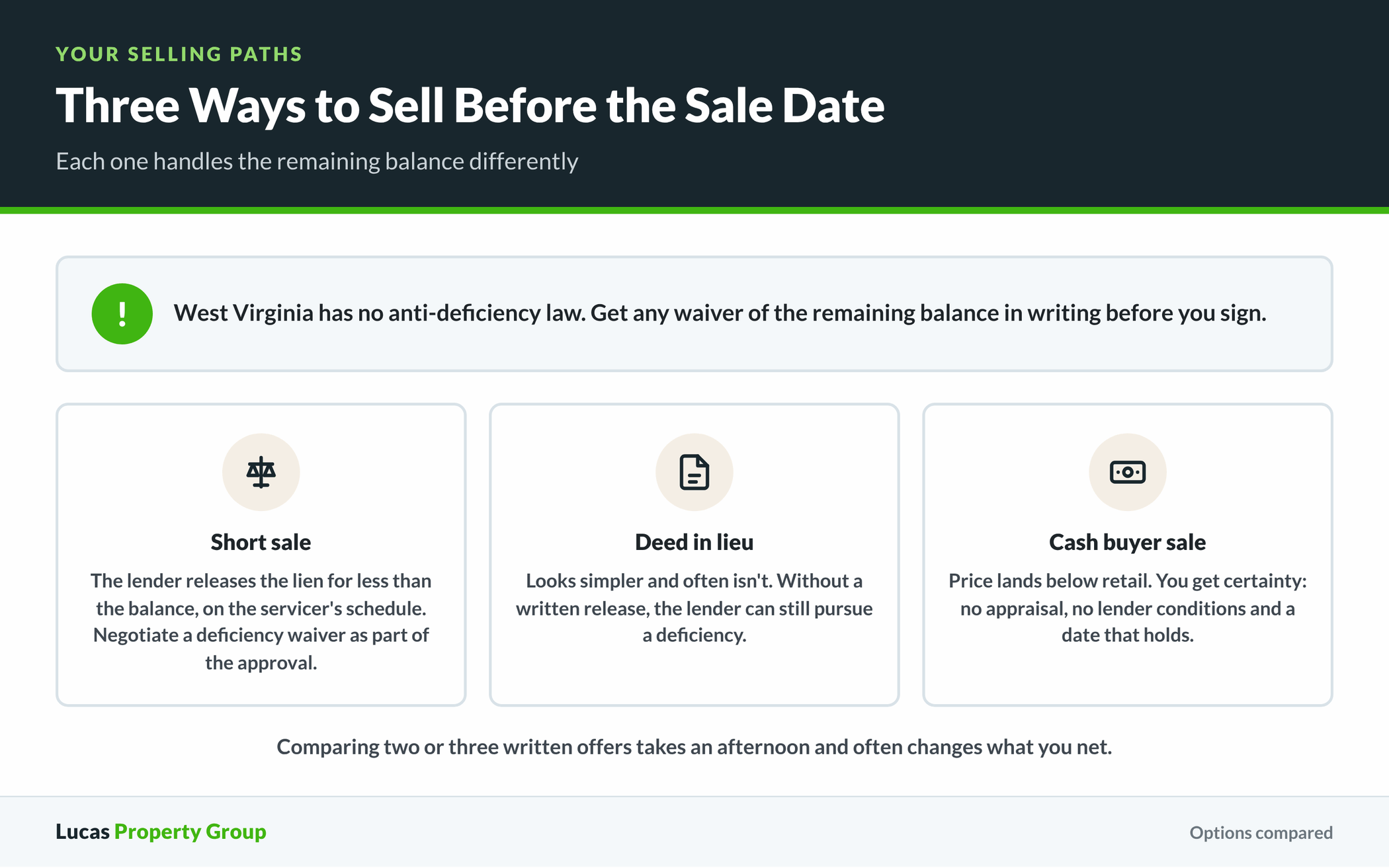
Auction companies and iBuyers also operate across the state, though coverage thins out once you leave the metro corridors. Get offers from more than one. Comparing two or three written offers takes an afternoon and routinely changes what a seller nets.
What Are Your Options If a Quick Sale Isn’t Right for Your Foreclosure?
A retired couple outside Beckley came to me convinced selling was their only move. Their servicer approved a modification six weeks later and they’re still in the house.
Keeping the home is sometimes the better answer, and I’d rather tell you that than buy a house from someone who didn’t need to sell. Free help exists. HUD-approved housing counselors help West Virginia homeowners with loss mitigation and lender negotiations at no cost. The West Virginia Housing Development Fund lists foreclosure prevention resources as well, and HUD’s site links to a map of certified agencies in the state.
Never pay an upfront fee to a foreclosure rescue outfit. Scammers target owners of a house in foreclosure, charging for services HUD-approved counselors deliver for free.
Loan modification, forbearance, and repayment plans all live under the loss mitigation umbrella. Federal rules require your servicer to review a complete application received early enough before it moves ahead with a sale. Getting the full package right matters. Incomplete packages get denied on paperwork, not on merit.
Borrowers with a WVHDF loan should start there. The Fund’s mortgage assistance is limited to its own borrowers, and you can reach it through wvhdf.com or by phone.
Bankruptcy stops a trustee’s sale cold through the automatic stay, but it’s a serious step with long consequences. Talk to a bankruptcy attorney, not a blog.
Renting the house out rarely rescues a foreclosure already in motion, because rent arrives monthly and the arrears are due now. A tenant in place can also narrow your pool of buyers when you finally do sell.
How Do You Confirm Your Foreclosure Sale Date in West Virginia?
For years I told sellers that the big online sites built for bargain hunters were the quickest way to read their own situation. It was backwards advice, because those sites exist to help buyers find you.
Legal notices are the real source. Trustees publish in a newspaper in the county where the property sits, so the legal section of your local paper carries the actual sale notice. Your county clerk’s office holds the recorded documents behind it.
National listing aggregators cover the state unevenly. Rural counties lag badly, and some listings stay up long after a sale has been postponed or canceled. Treating an aggregator’s listing as proof of your sale date is risky; confirm with the trustee named on your notice.
Want to know what a house in foreclosure might fetch? Look at active inventory instead. Roughly 10,614 listings were active statewide in September 2026, which tells you how much competition a listed home faces in your price band. A licensed agent can run a comparative market analysis free of charge. Most will do it knowing you might not list.
A landlord in Fairmont reached out the week his foreclosure notice arrived. He’d inherited a rental with a mortgage still on it. Its last tenant stopped paying months earlier, then left behind a garage full of scrap lumber and a furnace that quit in January. We closed before the sale date, and he told me the relief mattered more than the money. Patterns like that show up constantly. People hold on long past the point where holding on helps, because selling feels like failure and paying feels like responsibility.
Some sellers would rather skip the research and get a straight number on a house in foreclosure. Lucas Property Group will look at your property and tell you what we’d pay. We’ll also tell you what we think you’d net listing it instead, so you can compare the two side by side.
Frequently Asked Questions About Selling a House in Foreclosure in West Virginia
How Does the Foreclosure Process Work in West Virginia?
Most West Virginia foreclosures run out of court as a trustee’s sale under a deed of trust. You’ll get a notice of default first, then a notice of sale. The trustee publishes that notice in a county newspaper and mails you a copy by certified mail. The auction then happens without a judge. If your house sits near the Virginia line in the Eastern Panhandle, confirm which state’s law governs before you rely on anything you read.
Can I Sell My House in Foreclosure After the Sale Has Been Advertised?
You can, right up until the trustee conducts the sale. Advertising doesn’t strip your ownership or your ability to convey title. It does compress your timeline hard, so a buyer who needs a mortgage is usually the wrong fit at that stage. A cash buyer, or one with financing already approved, fits that window better.
Will Selling a House in Foreclosure Hurt My Credit as Much as the Foreclosure Itself?
Generally no. A completed foreclosure is one of the heavier marks a credit file can carry, and closing before the trustee’s sale avoids that entry altogether. With a short sale, the account still shows up as a settled debt and does some damage, just typically less, with a shorter recovery window.
Do I Owe Anything After the House Sells If the Price Doesn’t Cover My Loan?
Possibly, since the lender keeps the ability to pursue the shortfall through the court process described earlier in this article. That’s exactly why the written approval language on a short sale matters so much, and why a deed in lieu without a release can backfire. Get any waiver of the remaining balance in writing before you sign.
How Fast Can a Cash Buyer Close on a House in Foreclosure in West Virginia?
Two to three weeks is normal once title comes back clean, and tighter is possible when the trustee and servicer cooperate. The limiting factor is almost never the buyer’s money. It’s how quickly the payoff statement and lien releases get produced, so order your payoff early.
Can I Stay in the Home After I Sell It?
Occasionally, yes. Some investors, including our team, will negotiate a short post-closing occupancy so a family isn’t moving the same afternoon the sale funds. Ask about it before you sign anything, because it’s far easier to write into the contract than to add later.
Foreclosure Help for Morgantown Homeowners
This part of the state sits close to home for us, and the local market still gives sellers room to work. Redfin’s mid-year review put the Morgantown area’s median sale price near $306,600 for the first half of 2026, about flat with a year earlier. Active listings climbed roughly 11.5% over the same stretch. A house in foreclosure that needs work now competes with more inventory than it did last year.
Owners in Monongalia County or nearby can see how we buy locally on our page for Morgantown homeowners.
We also buy houses that came through an estate, so an inherited house in probate can follow the same path.
Talk With Lucas Property Group About Your Sale Date
You can sell a house in foreclosure in West Virginia right up until the trustee’s sale. The earlier you start, the more choices you keep. Send us your address and your sale date, and we’ll give you a written cash offer with no obligation. If a counselor or a loan modification fits you better, we’ll tell you that too. An honest opinion about your timeline costs nothing. Contact Lucas Property Group whenever you’re ready. Someone on our team will call you back.
Helpful West Virginia Blog Articles
- How to Do Sale by Owner in West Virginia
- How to Sell a House with a Code Violation in West Virginia
- How to Sell a Probate House in West Virginia
- How to Sell a Hoarder House in West Virginia Without the Stress
- Who Pays Taxes When You Sell a House in West Virginia
- Can You Sell a House in Foreclosure in West Virginia
- How to Sell a House After Divorce in West Virginia