
A sister called me on a Tuesday after the fire marshal had stopped by. Her brother’s place outside Charleston had boxes stacked to the ceiling in every room. She couldn’t decide whether to call a cleaning crew, a Realtor or an attorney first. If you’ve got a hoarder house in West Virginia on your hands right now, you’re probably running that same loop. You have several paths forward, and some of them cost less than the full cleanout most families start with.
What Is a Hoarder House and Why Does It Matter in West Virginia?
Before: a two-story in Parkersburg with narrow trails between stacks of newspapers and forty years of mail. After: a family that closed in under three weeks and never rented a single dumpster.
Calling a hoarder house messy undersells it. Research shows how common this is, since a meta-analysis of eleven studies pegged hoarding disorder at roughly 2.5 percent of people, or about one in forty. Run that against a state of 1.7 million and the arithmetic gets uncomfortable.
Why does it hit harder in West Virginia? Plenty of these houses went up before 1950, with knob-and-tube wiring, coal-era chimneys and basements that take on water every spring. Stack forty years of belongings on that frame and moisture gets trapped against the plaster. Pests find a food source, and floor joists end up holding weight they were never built for.
Market conditions matter too. As of September 2026, the statewide median sold price was around $230,000, with homes taking a median of 57 days on market and selling at roughly 99 percent of list. Yours won’t follow those rules, because the buyer pool shrinks to people who can see past the contents.
Early last year I worked with two adult children in Hurricane whose mother had just moved into assisted living over in Teays Valley. Her garage held nine chest freezers, only two of them plugged in. The kids were paying for the facility out of pocket while the house sat, and they needed those carrying costs to stop.
What Are the Legal and Safety Issues When Selling a Hoarder House in West Virginia?
You can sell this house without lying, and you don’t have to pretend the contents aren’t there.
West Virginia treats seller disclosure differently from most of our neighbors. State law doesn’t make you hand a buyer a formal disclosure statement, and courts here enforce caveat emptor clauses in sales contracts. None of that lets you hide a sinking foundation. Your exposure comes from common-law fraud and concealment claims rather than a statute. For that reason, most sellers still fill out an industry disclosure form on their own to head off disputes. I’d always complete one. Silence looks like concealment later, while a signed form reading “unknown, property sold as-is” looks like candor.
Homes built before 1978 fall under the Residential Lead-Based Paint Hazard Reduction Act, which covers every state. So much of our housing predates that line that you should assume yours is in it.
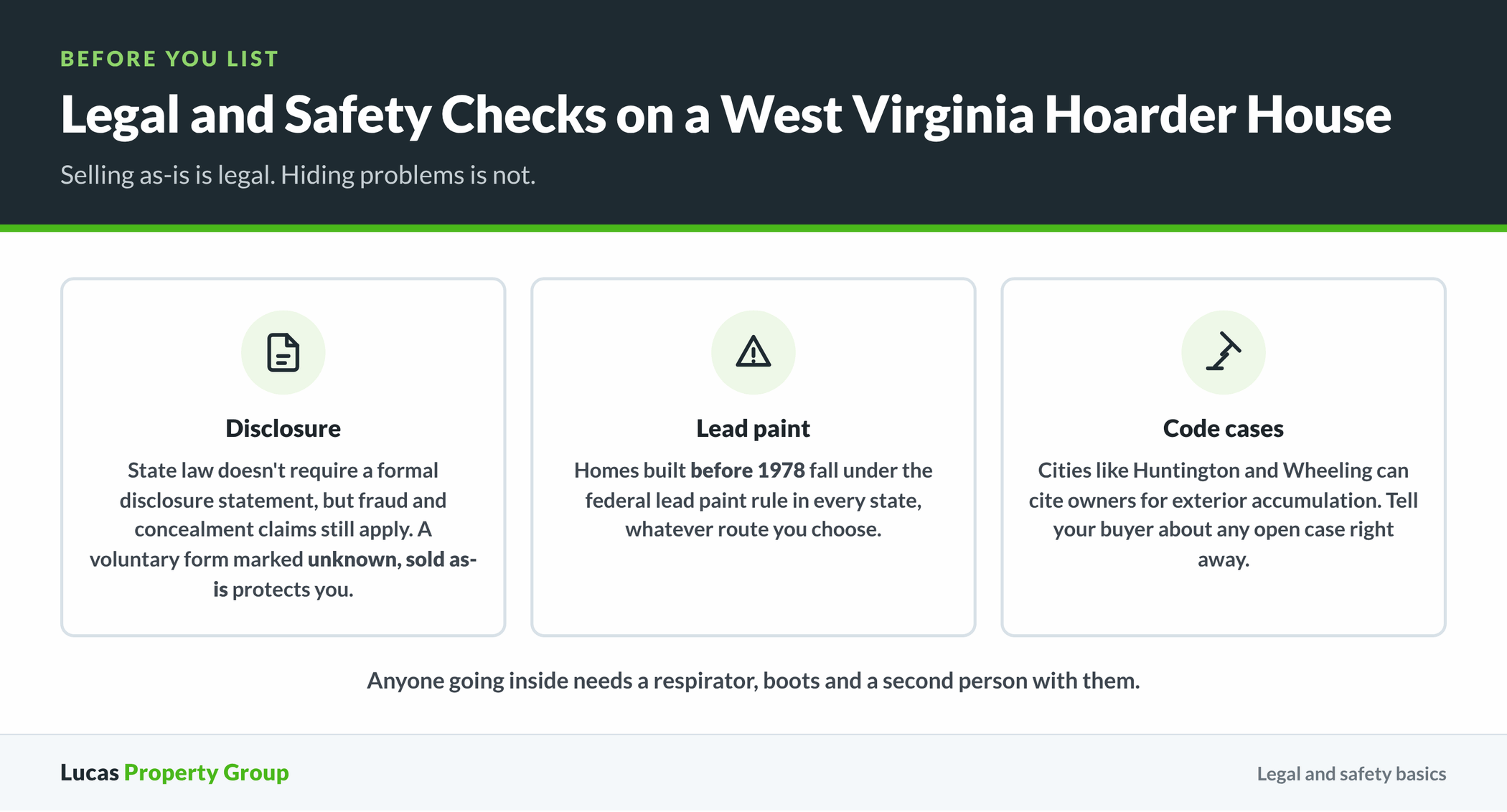
Stacked material blocks the exits. Rodent waste goes airborne when you disturb it. A space heater or an overloaded outlet buried under a pile of fabric is a real fire risk. I’ve walked into houses where nobody could reach the panel box at all. Anyone going inside needs a respirator, boots and a second person along.
Code enforcement in towns like Huntington or Wheeling can cite an owner for exterior accumulation and unsafe structures. If you already have a citation, tell your buyer right away, because hiding an open code case blows up closings. Title companies find these things.
What Does It Cost to Clean Out a Hoarder House Before Selling?
Most families spend more cleaning out a place like this than they get back in sale price, and nobody warns them before the first dumpster shows up.
Industry figures cover a wide range. Cleanouts commonly run $1 to $2 per square foot, or $1,000 to $4,000 for most homes, and severe biohazard or structural cases climb to $10,000 and well past it. A roll-off dumpster you load yourself costs a few hundred dollars up to about $800 for a week, with overage fees adding $40 to $100 for every extra ton. Packed houses need three, four or even six of those pulls.
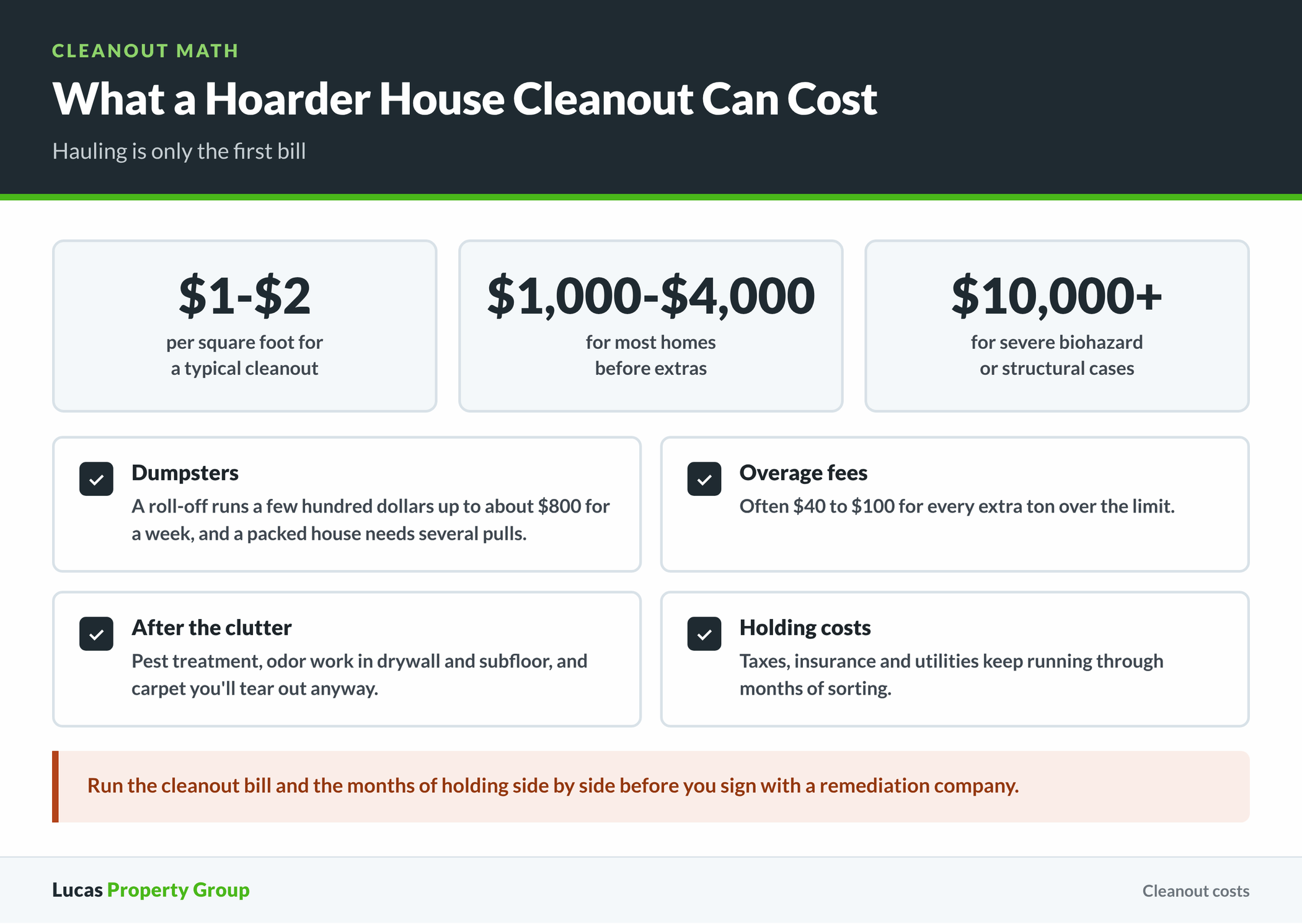
Doing the sorting yourself can take a family four months, since somebody has to open every box before it hits the truck. Deeds, savings bonds and wedding rings really do turn up in the strangest places. All the while, taxes, insurance and utilities keep running, so the clock never stops just because the work feels paused. I’ve watched cleanout projects in Morgantown and Beckley drag across an entire summer as the carrying costs quietly ate whatever the cleanup was supposed to earn.
Once the clutter’s out, you’ve still got pest treatment, odor work in the drywall and subfloor, and carpet that’s coming up anyway. Insurance gets tricky too, because some carriers won’t write a vacant policy on a property with documented hazards.
Does a cleaned-up house in West Virginia sell for more? Usually. Even so, the gain rarely covers $12,000 in cleanup plus five months of holding. Put those two numbers side by side before you sign with a remediation company.
Can You Sell a Hoarder House as Is in West Virginia?
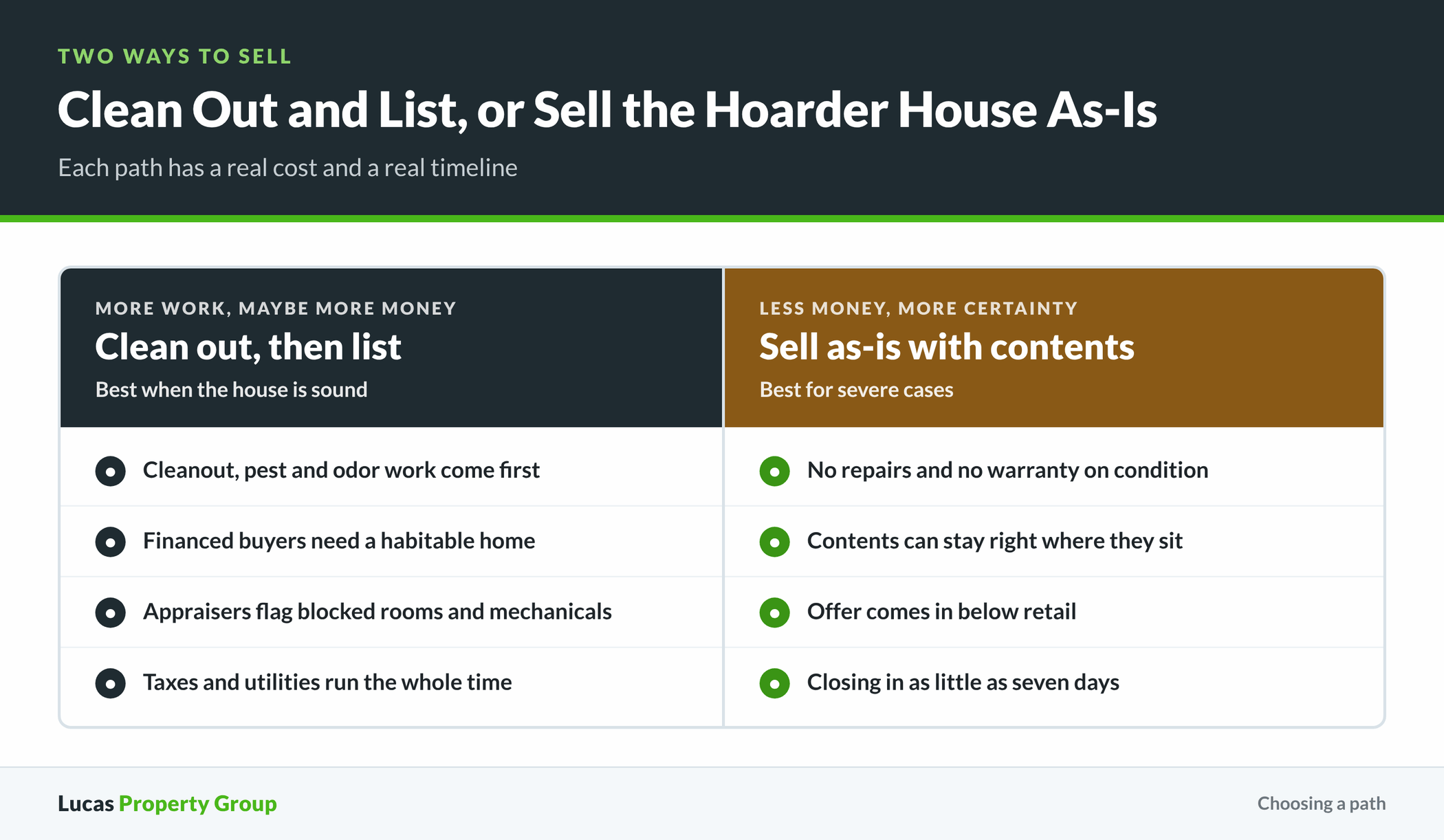
So do you have to clean the house out before you sell? That math is exactly why as-is is a real option here and not a consolation prize. Selling as-is is legal in West Virginia, which means no repairs and no warranty on condition.
Leaving the contents behind is frequently the smartest move. When an investor buys it with everything inside, you’ve handed off the cleanout along with the roof. Take what matters and walk away from the rest.
Financed buyers are where as-is gets messy. An appraiser on an FHA or VA file will flag blocked rooms, missing handrails and mechanicals nobody can reach, and conventional lenders want a habitable property too. One West Virginia hoarder house I looked at in the Eastern Panhandle went under contract three times with retail buyers. Only then did the sellers accept that the financing was never going to clear.
List one at clean-house comps and wait for someone to see the potential, and you’ll sit. A traditional agent sale in West Virginia takes months once you add the weeks a financed buyer needs to close to the time the listing sits. Throw in failed inspections and a relisting or two, and you’re well into next season.
Price it like a regular home and you’ll spend every weekend for half a year explaining the smell to strangers. Is that how you want to spend this spring?
Is a Cash Buyer the Best Option for a Hoarder House in West Virginia?
“Am I going to get ripped off?”
Expect any cash offer on this kind of property to come in under retail. The buyer takes on the cleanout, the unknown repairs and whatever’s hiding behind the piles. In return you get certainty, speed and nothing out of pocket, which counts most for sellers who can’t front more money. Selling to a cash buyer in West Virginia can shrink the timeline to as little as seven days, a fraction of a typical agent sale.
Now, if the structure’s sound, the clutter is moderate and you’ve got family willing to give up some weekends, listing after a cleanout may net you more. Do the math, then decide.
Cash clearly wins in some situations. Probate properties with several heirs who can’t agree are one. Homes with active code violations are another, and so are places where a parent’s care is being paid for out of the equity. It also wins with any hoarder house carrying pest or mold problems no lender will touch. At Lucas Property Group, we buy houses in this condition across West Virginia and don’t ask sellers to clean, repair or stage anything first.
Vet whoever you talk to. Ask for proof of funds, ask how many houses they’ve closed locally, and ask whether they plan to assign the contract to someone else. Anyone who can’t answer those three in a single phone call isn’t really a buyer, and you’d find that out at the closing table.
How Do You Find a Realtor Who Understands Hoarder House Sales in West Virginia?
Hire the wrong agent and you’ll lose four months, two price cuts and a contract that dies at the appraisal.
Most agents are honest and good at their jobs, but most have never marketed a hoarder house. They’ll shoot the exterior, write “handyman special” and wait.
What should you ask in the interview? Start with how many distressed or estate properties they’ve closed in the past two years. Ask which investors and contractors in your county they know by name. Find out whether they’ll show the property to their cash buyer list before it ever hits the MLS. An agent in Charleston, Martinsburg or Clarksburg who works probate and estate sales has that list. Someone who sells twelve polished homes a year usually doesn’t.
Listing and buyer’s agent commissions in West Virginia are negotiable, same as anywhere. On a hoarder house you’ve got extra room to push, especially if the agent is bringing the buyer.
Be wary of the agent who promises a retail number just to win the listing. I’ve watched it play out dozens of times. The price drops twice, the listing goes stale, and the eventual sale lands below what a direct buyer offered in week one. A stale listing on a hoarder house costs you in ways that are hard to see until it’s over.
Ask every candidate to walk the property in person before quoting a price. An agent who emails you a number without seeing the inside of a West Virginia hoarder house is guessing.
Should You List Your Hoarder House with a Realtor Who Offers Concierge Services?
A widow in Weirton had a hoarder house her late husband filled over thirty years, including a basement packed with radio equipment. One agent offered to front the cleanout and repairs, get paid back at closing, and list the home at full retail.
Concierge programs (agents advancing renovation money and getting repaid from the proceeds) are built for homes where $15,000 of work adds $40,000 of value.
A severe hoarder house usually isn’t one of those. When the subfloor’s rotted and the HVAC has pushed air through contaminated ductwork for ten years, the repair budget blows past anything a concierge program will advance. Then you’re asked to cover the overage yourself, and suddenly you’re funding a renovation on a house you were trying to leave behind.
Some programs charge interest or a fee on the money they advance, and others take their cut at closing with no carrying charge. Ask directly whether you owe the money if the property never sells, since terms differ by brokerage.
Here’s my view on concierge service. It makes sense for a light-to-moderate hoarder house in a strong submarket like Jefferson or Berkeley County, where retail demand runs hot. Statewide, the median list price sat at $259,900 in September 2026, and Eastern Panhandle towns consistently price above that. Out in the coalfield counties, values run thinner and the renovation money rarely pays for itself. There, selling as-is to a direct buyer like us leaves more in your pocket without the risk.
Get both numbers. Put a concierge projection and a direct cash offer side by side, on paper.
How Do You Sell a Hoarder House in West Virginia?
Utility access decides your timeline more than anything else. Appraisers, inspectors and most buyers need the power and water on. If service has been off for years, your utility may want an electrician’s certification before reconnecting a house in rough shape.
Get a copy of the deed from your county clerk, confirm whose names are on it and check for liens or delinquent taxes. Heirs frequently learn halfway through a cleanout that the deed never got transferred after a death, and probate adds months. Your county clerk’s office can tell you exactly what’s recorded and what a transfer will involve.
Next, sweep for valuables and documents before anything moves. Make one pass with two people, a labeled box for paperwork and a second box for anything with sentimental weight.
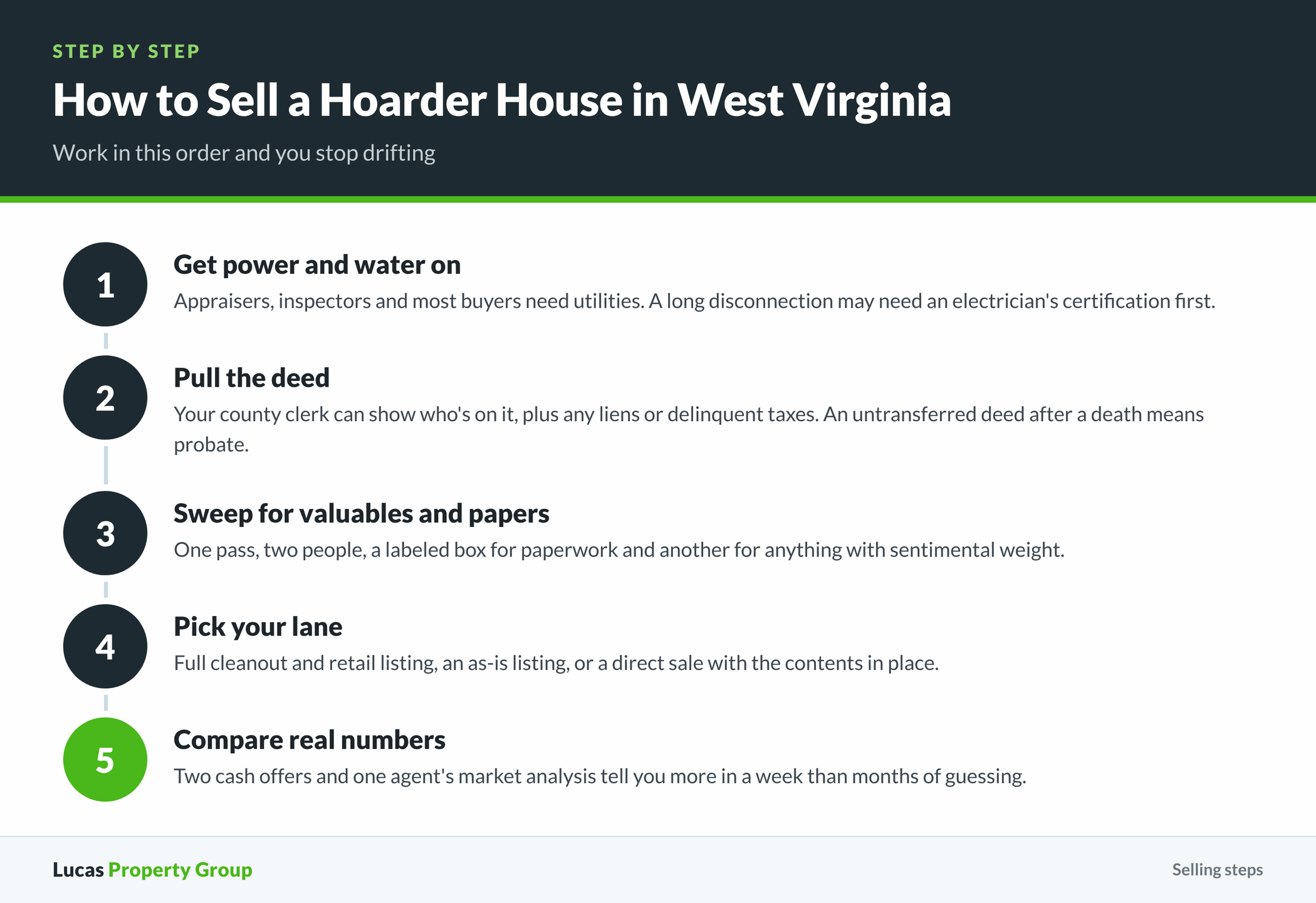
Then pick your lane. That means a full cleanout and retail listing, an as-is listing with an agent who knows the project buyers, or a direct sale with the contents left in place. Each comes with a real cost and a real timeline. The worst outcome is drifting between all three for a year as the hoarder house sits empty and the roof keeps aging.
Two cash offers and one agent’s market analysis will tell you more in a week than three months of guessing.
A homeowner near Fairmont took a job transfer that gave him five weeks to get out of a hoarder house his father left him. It was a split-level with a workshop full of half-finished lawnmowers. He kept the toolbox and a fishing rod. We closed on a Friday before his start date, and everything else stayed right where it sat. He saw early that five weeks and a cleanout don’t fit in the same box.
Frequently Asked Questions About Selling a Hoarder House in West Virginia
What Counts as a Hoarder House?
A property crosses into hoarder house territory once belongings stop the rooms from working: you can’t sleep in the bedroom, cook in the kitchen or get to the furnace. Clinicians look at the owner’s distress about discarding things, not just the sheer volume. For selling purposes in West Virginia, what counts is whether an appraiser can see the mechanicals and whether a buyer can walk the floor plan safely.
Do I Have to Tell Buyers About the Condition?
You’re not required to volunteer a formal written statement under state law, but you can’t actively hide defects or answer questions dishonestly. Filling out the voluntary industry disclosure form, even with most lines marked “unknown,” protects you better than leaving it blank. Pre-1978 homes carry the federal lead paint obligation whichever route you choose.
Will a Lender Finance a Hoarder House in West Virginia?
Usually not, at least until the property’s cleared and the systems are reachable. Appraisers on government-backed loans flag blocked exits, inaccessible utilities and visible hazards, and conventional lenders want habitable condition. That’s why cash and renovation-loan buyers dominate this corner of the West Virginia market.
Should I Clean It Out Myself First?
Only if you’ve priced the whole job honestly, including the hauling, the pest work and the months of mortgage and utility payments during the sorting. Plenty of sellers come out ahead by cleaning first, and plenty come out behind. Get quotes and stack them against a direct offer before you rent anything.
Can I Sell a Hoarder House That’s Stuck in Probate?
Yes, though the executor needs legal authority before signing, and the process depends on how the estate was set up. Your county clerk’s office can confirm what’s been filed and what’s still outstanding. Buyers who regularly handle estate properties don’t mind waiting on that paperwork, so don’t let probate alone keep you from gathering offers.
How Fast Can a Hoarder House in West Virginia Close?
With a direct buyer and clean title, closings happen in a week or two, mostly limited by how fast the title company can run its search. Liens, multiple heirs or an unreleased mortgage from decades back add time. A traditional listing runs several times longer once you count the marketing period and the financing contingency.
Hoarder Houses Around Morgantown
A lot of the houses we see come from Monongalia County and the towns nearby, and we buy them in whatever shape they’re in. Homes in Morgantown spent a median of about 85 days on the market in the first half of 2026, according to Redfin, roughly nine days longer than a year before. A packed hoarder house that needs work tends to sit even longer, which is worth weighing before you start a cleanout.
Talk Through Your Hoarder House With Us
If you’re sitting on a hoarder house anywhere in West Virginia and can’t tell which direction makes sense, we’re glad to walk through it with you and give you honest numbers. That’s true even if the answer turns out to be listing with an agent instead of selling to us. Call or reach out whenever you’re ready. No pressure, no obligation and no judgment about what’s inside.
You don’t need to clear a single room before you call. Tell us what shape the house is in and where things stand with your family, and we’ll lay out what a cleanout listing and a direct sale would each look like. When you’re ready, contact Lucas Property Group and we’ll take it from there.
Helpful West Virginia Blog Articles
- How to Do Sale by Owner in West Virginia
- How to Sell a House with a Code Violation in West Virginia
- How to Sell a Probate House in West Virginia
- How to Sell a Hoarder House in West Virginia Without the Stress
- Who Pays Taxes When You Sell a House in West Virginia
- Can You Sell a House in Foreclosure in West Virginia
- How to Sell a House After Divorce in West Virginia