
A stair railing three inches too low can cost you a buyer. Not because the railing is dangerous, but because an appraiser wrote it down, the lender flagged it, and suddenly a financed transaction has a condition nobody wants to pay to clear. The strange math of selling a house with a code violation in West Virginia is this: small problems carry big consequences, and big problems sometimes carry none at all. I’ve bought houses across this state for years, and I want to walk you through exactly how this works.
What Counts as a Code Violation on a West Virginia House?
One seller in Fairmont got a letter about a back porch her late father built in the nineties. Six months later she sold the house without touching the porch, since her corner of the county never adopted the code the letter referenced.
West Virginia’s building code isn’t automatic the way it is in most states. The State Fire Commission writes the statewide code, the State Fire Marshal holds enforcement authority, and individual counties and cities decide whether it applies at all. Local jurisdictions that adopt it are the ones responsible for enforcing it, which you can read for yourself in the Title 87 Series 4 legislative rule.
So what trips the wire? Unpermitted additions top the list, and finished basements with no egress window come right behind them. Electrical panels someone upgraded over a weekend. Plumbing systems rerouted by a handyman who never pulled a permit. Missing handrails on exterior steps. Roof repairs done without inspection.
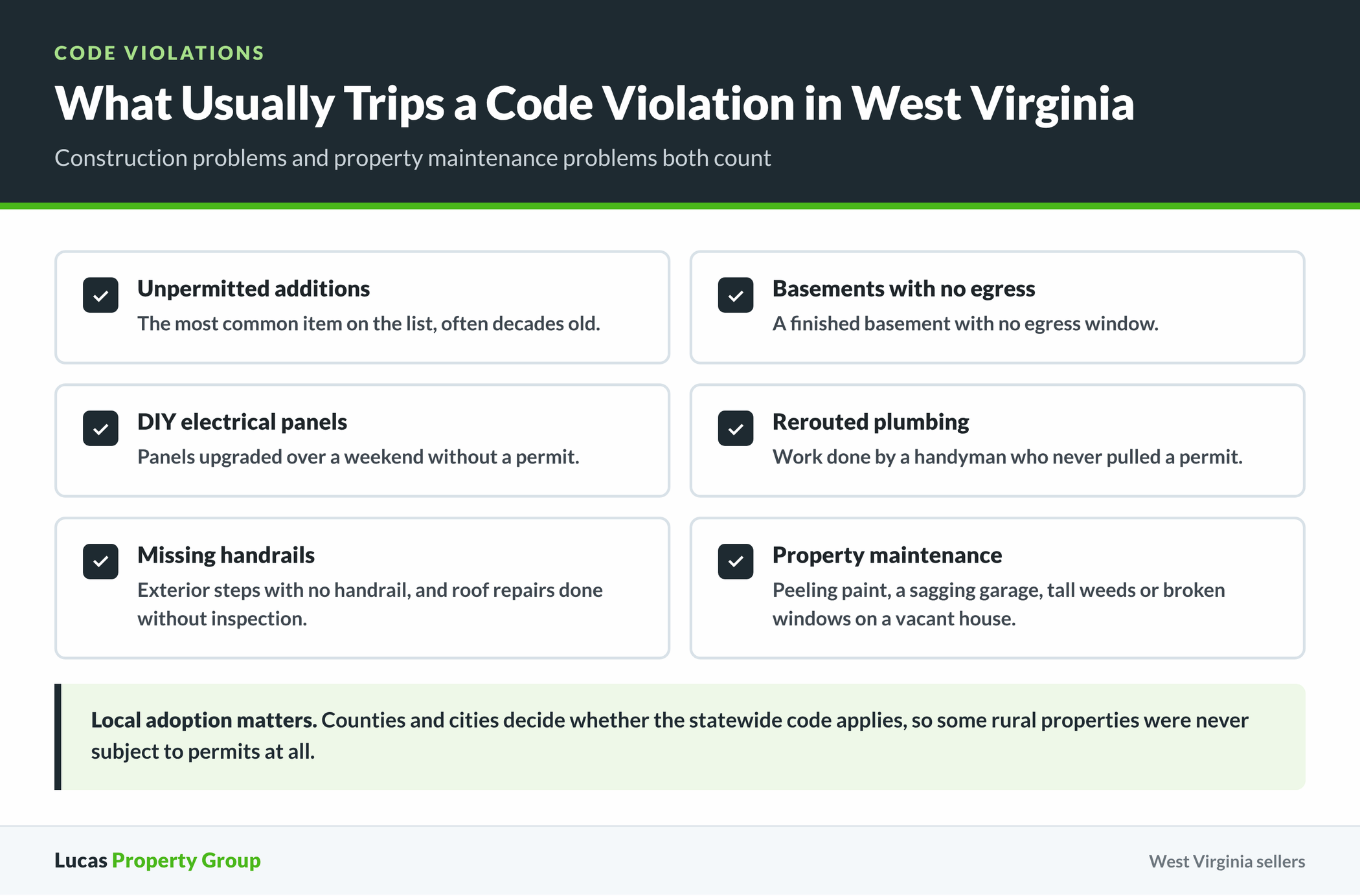
A code violation can also come from the property maintenance side rather than construction. This means peeling exterior paint, a sagging garage, tall weeds, or broken windows on a vacant structure can all trigger one. Charleston requires vacant structures with missing windows or doors to be secured, and if the owner doesn’t respond, the city can secure it and bill the owner.
Zoning problems are a separate animal from building codes, though homeowners lump them together. A duplex conversion in a single-family zone is a zoning issue, while a deck without a permit is a building issue. Both can stall a sale, and both are worth sorting out before a buyer’s attorney finds them.
Does every West Virginia house with an old addition have a code violation? No. Plenty of rural properties were built where no permit was ever required.
How Do Code Violations Get Found on Your Property?
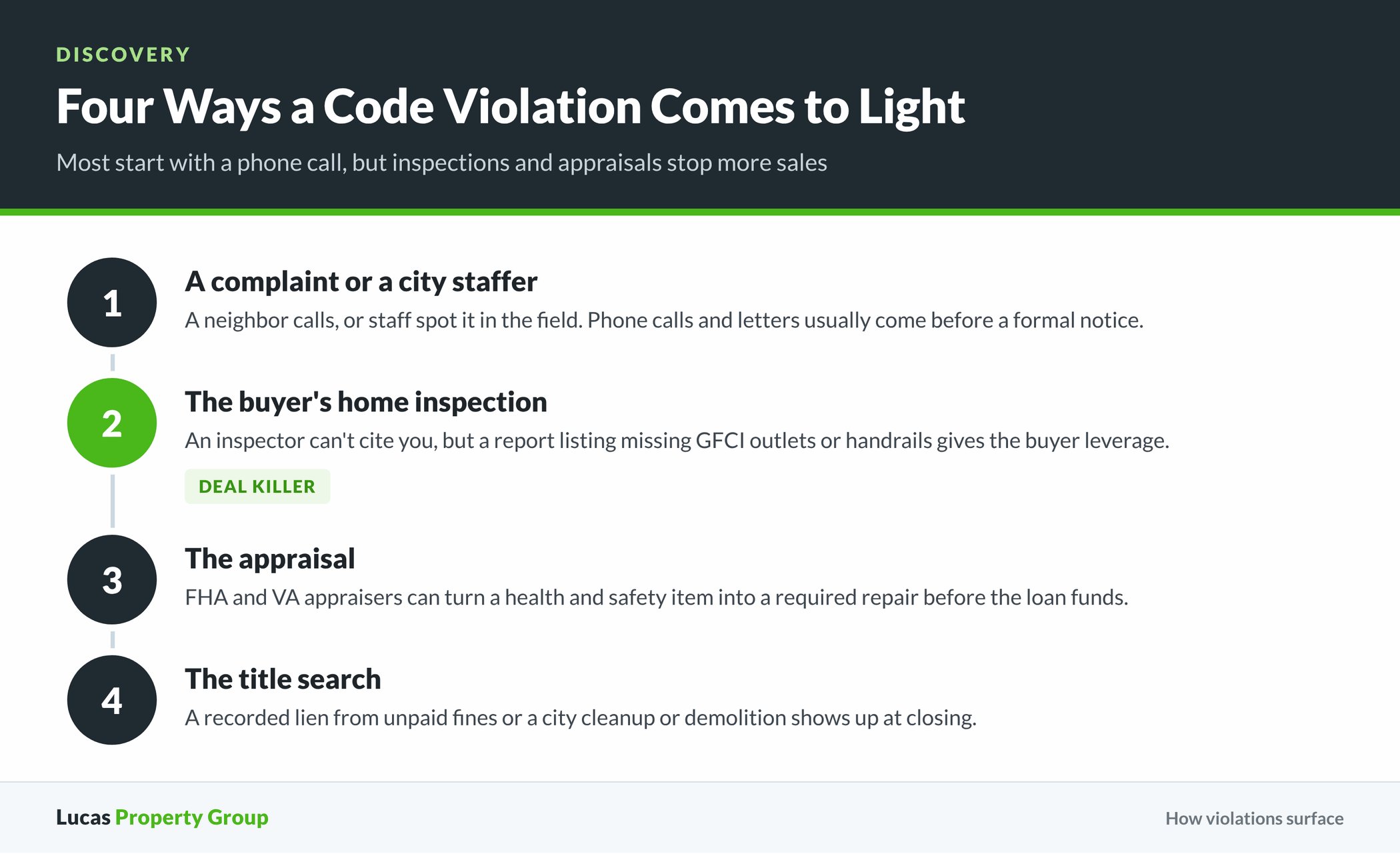
A neighbor calls. That’s how most of these start.
In Charleston, some violations come from concerned citizens and others get spotted by staff in the field, with zoning administrators assigned by neighborhood zone. Those administrators usually try phone calls and letters first, so formal notices of violation follow only when nothing gets resolved. You can see how the city handles it on the Charleston code enforcement page.
The second discovery path is the one that actually kills contracts: the home inspection. A buyer’s home inspector isn’t a code official and can’t cite you. But an inspection report listing missing GFCI outlets, no handrails, or a water heater with no expansion tank gives the buyer leverage in negotiations.
Appraisals are the third path. An FHA or VA appraiser has property condition standards baked into the assignment, and a code violation affecting health and safety can turn into a required repair before the mortgage funds. Conventional lenders flag items too, just less aggressively.
Then there’s the title search. In Parkersburg, demolition notices have warned owners that if a building isn’t repaired or demolished by the stated date, the city may act. The city may demolish it and pursue a lien against both the owner and the real estate. A recorded lien shows up at closing whether you remembered it or not.
What about permits? Many West Virginia county and city offices keep permit records searchable, and comparing what’s on file against what’s physically standing on the property tells you most of what you need to know.
Can You Sell a House with Code Violations in West Virginia?
Hide an open enforcement order and you can end up with a buyer walking at the closing table. Your attorney holds a file nobody will insure. The house ends up back on the market with a stale listing history.
Yes, you can sell. There’s no law in West Virginia that freezes a property sale because a code violation exists. Houses with violations change hands here every week.
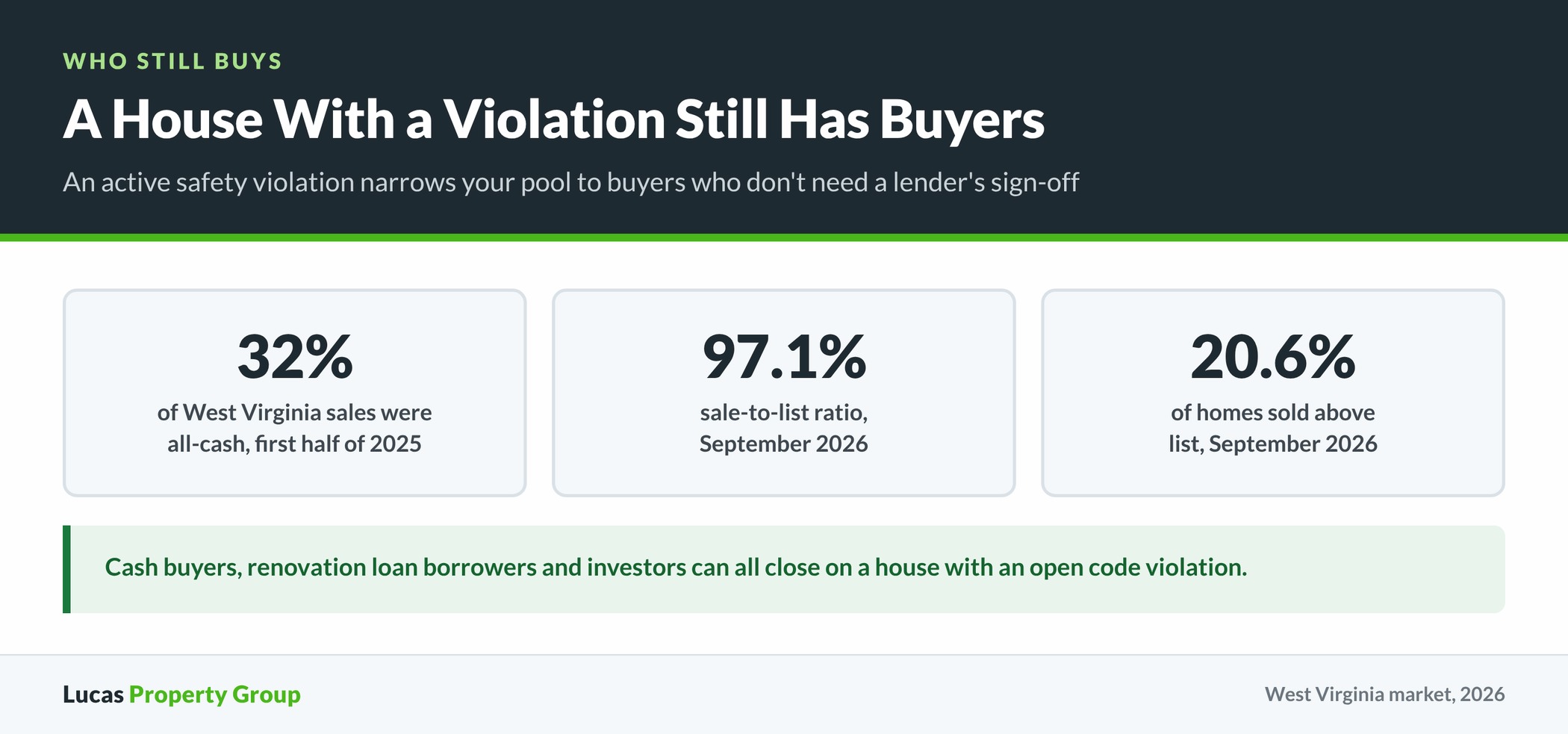
What changes is your buyer pool. Conventional and government-backed loans come with condition requirements, so a house with an active safety-related code violation narrows down to cash buyers, renovation loan borrowers, and investors. That isn’t a disaster. All-cash buyers made up about 32% of West Virginia home sales in the first half of 2025. A meaningful share of this market never involves a lender at all.
Things get complicated once there’s an active enforcement action. Under state law, a property owner facing a municipal enforcement agency has the right to appeal to circuit court for a temporary injunction. The owner also has the right to a hearing within 20 days of an enforcement agency order. The West Virginia University LEAP program’s overview of unsafe property ordinances explains how counties and municipalities structure these.
Early last year I bought a brick ranch in Barboursville from an heir living in Texas. He’d just gotten a job transfer and had five weeks to be out from under the house, which had an unpermitted carport and a garage full of his uncle’s fishing gear. We closed in nineteen days and he never flew back.
Sell with the code violation disclosed and priced in. Sell after fixing it. Both work. Pretending it doesn’t exist is the only approach that reliably blows up.
Do You Have to Disclose Code Violations to Buyers?
“If the state doesn’t make me fill out a form, why would I volunteer bad news?”
It is a caveat emptor state, meaning buyer beware, though the state does have laws against fraud. The West Virginia Association of Realtors offers a voluntary disclosure form that many sellers use, but it isn’t mandated statewide.
Caveat emptor protects you from a lot. It does not protect you from active concealment. Hiding a defect defeats the doctrine, because the seller has stopped letting the buyer beware and started preventing discovery. So painting over water-stained drywall above a known leak becomes a different act than staying quiet.
My position, and some agents disagree with me: disclose the code violation in writing anyway, and put it in the contract, not just in an email. A buyer who signs knowing about the unpermitted addition has a much harder time coming after you later than a buyer who found out from the appraiser.
If a West Virginia city has issued you an actual notice of violation, hand the buyer a copy. The document travels with the property in practice, since the next owner inherits the obligation to fix it.
Federal law treats lead-based paint as a separate matter. Sellers have to disclose lead-based paint hazards on homes built before 1978, and that applies in every county there regardless of local code adoption. Legal Templates’ West Virginia summary lays out both rules side by side.
One more practical note: West Virginia requires an attorney at closing. The attorney will ask questions. Better that your answers match your paperwork.
How Do Code Violations Affect Your Home’s Sale Price?
For years I assumed a code violation knocked exactly its repair cost off the price. Wrong, and not by a little.
A $4,000 electrical repair with an unknown scope behind the drywall gets priced like a $12,000 problem, since the buyer is covering themselves for what they can’t see. The discount shrinks the moment you hand over a written contractor estimate.
How much pain you absorb comes down to market conditions. In September 2026, West Virginia home prices were up 4.5% year over year to a median of $259,255, with a median of 55 days on market, per Redfin’s state housing data. That same month, 20.6% of West Virginia homes sold above list price and the sale-to-list ratio hit 97.1%. Demand like that absorbs a disclosed defect better than a soft market would.
A house in Morgantown near the WVU campus draws investor interest that a comparable property in a shrinking coalfield town simply won’t. Those buyers have renovation budgets.
Structural and safety items hit hardest. Foundation movement, knob-and-tube wiring, a condemned sewer lateral. Cosmetic property maintenance violations barely move the number once the house is otherwise sound.
Here’s the discount I keep seeing: a disclosed, documented code violation costs roughly what the repair costs plus a modest risk premium. An undisclosed one found at inspection costs that plus your negotiating position.
What Happens If You Fix Code Violations Before Selling?
Pulling a retroactive permit on a fifteen-year-old addition in a West Virginia municipality can mean opening walls so an inspector can see the framing.
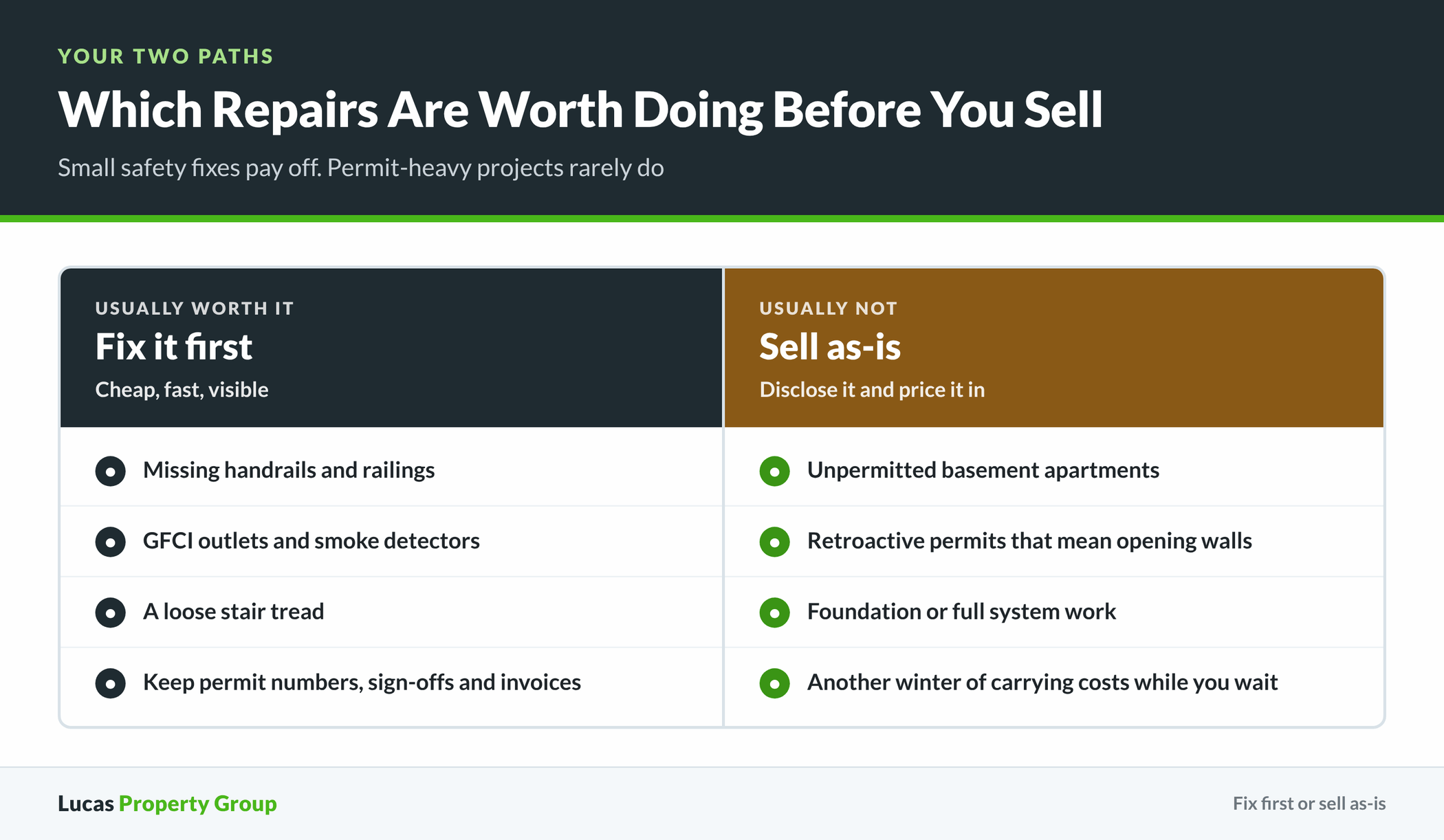
Fixing first works beautifully in specific cases. Missing handrails and railings, GFCI outlets, smoke detectors, a loose stair tread. These are cheap, fast, and they remove the exact items a home inspector will list in bold.
Big structural corrections rarely pay you back. An unpermitted basement apartment brought up to current egress and fire separation standards can run into real renovation money, and the appraisal won’t credit you dollar for dollar. You’re buying access to financed buyers, not value.
Timing deserves a hard look. Realtor.com data for September 2026 put West Virginia at about 57 days on market with median rent near $1,297 a month. Add a permit cycle, contractor scheduling, and an inspection, and you’ve carried the property through another winter of heating bills. West Virginia winters are not cheap to heat an empty house through.
Most sellers haven’t.
When you do fix a code violation, document everything. Permit numbers, final inspection sign-offs, contractor invoices, photos during the work, since that folder is worth real money at the negotiating table, and it kills the buyer’s uncertainty discount dead.
A fair number of sellers I meet have already spent six months and serious cash chasing code compliance before calling me, and they’d have netted more selling as-is on day one. Not always. But often enough that I mention it.
What’s the Fastest Way to Sell a House with Code Violations?
List it as-is at a fair price, get an offer in two weeks, close in thirty days. That’s the plan on paper. Then the buyer’s lender orders an appraisal, the appraiser notes the deteriorated roof, underwriting demands repairs before funding, and you’re sixty days in with a dead file and no leverage.
Cash buyers and investors buy properties with an open code violation routinely, because they’re underwriting the renovation themselves.
Auction is another route, though West Virginia’s auction market for residential property is thin outside of estate and tax sales.
Wholesalers will contract your house and assign it. Some are excellent. Some tie up your property for 45 days and then vanish, which leaves you worse off than when you started. Ask any buyer directly whether they’re purchasing or assigning.
Direct buyers like Lucas Property Group work this part of the West Virginia market specifically, buying houses with code violations as they sit, with no repair requests and no appraisal condition. The tradeoff is honest: you trade some price for certainty and speed.
Whichever path you pick, resolve any recorded municipal lien before or at closing. Your closing attorney handles the payoff, but the money comes from your side of the settlement statement. Surprises there delay funding.
How Do You Talk to Buyers About Code Violations?
“Won’t telling them scare off every buyer I’ve got?”
Lead with documentation, not apology. Give the buyer the notice of violation, any contractor estimates you’ve gathered, and the contact for the local code enforcement office. Transparency shortens negotiations, because there’s nothing left to discover.
Frame the price around the violation instead of defending the price. If a buyer knows your asking number already reflects a $9,000 electrical correction, they stop treating the code violation as a discovery and start treating it as a line item.
Avoid guessing at repair costs out loud. “I don’t know, here’s the estimate I have” beats a confident wrong answer every time.
Know which buyers to stop courting. A first-time buyer with an FHA loan and a three percent down payment cannot close on a house with an active safety-related code violation, no matter how much they love the kitchen. Letting that buyer tie up your property for six weeks helps nobody.
A couple in Weirton had a contractor quote to bring their kitchen plumbing and wiring up to code that ran past what the whole kitchen was worth. They’d been sitting on the quote since a Tuesday in early spring, unsure what to do, with the dishwasher still in the box in the garage.
Keep your communication in writing. If a West Virginia buyer’s attorney asks later what was disclosed and when, you want a timestamp, not a memory. Sellers who do this almost never end up in a dispute over a code violation after closing.
Frequently Asked Questions
Can a Buyer Back Out After Finding a Code Violation During Inspection?
Usually yes, if the contract has an inspection contingency, which most West Virginia purchase agreements do. That’s exactly why disclosing a known code violation upfront protects you: a buyer who signed with full knowledge has far less room to walk and far less leverage to renegotiate. Contracts written as true as-is sales with no inspection contingency are a different situation, and those typically come from cash buyers.
Will a Code Violation Prevent Me From Getting Title Insurance?
A code violation by itself generally doesn’t block title insurance, since title work looks at ownership and recorded encumbrances rather than building condition. What does cause trouble is a recorded municipal lien from unpaid fines or a city-performed cleanup or demolition. Your closing attorney will find it in the search and arrange payoff from your proceeds.
Does the New Owner Inherit the Code Violation After Closing?
In practice, yes. Enforcement attaches to the property, so the next owner takes on the obligation to correct the condition, though any fines already assessed against you personally can still follow you. That dual reality is why buyers price violations carefully and why handing over the actual paperwork matters so much.
Do I Need a Permit History Before I Can Sell?
You don’t need one to sell, but getting one is cheap insurance. Call the building or planning office in the municipality where the property sits and ask what permits are on file. Comparing that list to what’s physically built tells you whether an addition, deck, or basement finish will raise questions during the sale.
Are Rural West Virginia Properties Really Exempt From Building Codes?
Many are, functionally. Because adoption is local, large unincorporated stretches of the state have no building code enforcement and no permit requirement, so there’s no code violation to cite. Lenders and appraisers still apply their own property condition standards, though, so an unsafe structure can still kill a financed transaction even where no local official will ever write you up.
Is It Cheaper to Fix the Violation or Sell As-is?
Depends entirely on the item. Small safety corrections are almost always worth doing yourself before listing. Anything requiring permits, inspections, and opened walls usually costs more than the price bump it earns. That’s especially true once you count the extra months of taxes, insurance, and utilities on a house you’re not living in.
If you’ve got a West Virginia house with a code violation hanging over it and you’re not sure which direction makes sense, I’m happy to talk it through. Sometimes the right answer is fixing a few things and listing. Sometimes it’s selling as-is and being done. Reach out to Lucas Property Group whenever you’re ready, and if all you want is a second opinion on your options, that’s fine too. No pressure, no obligation.
Code Violations and the Morgantown Market
Morgantown is where we buy the most houses, and the market there still rewards sellers who price a known problem honestly. Redfin put the median sale price in Morgantown at about $306,627 for the first half of 2026. A house with an open code violation won’t fetch that number as-is, but it doesn’t have to sit either. If you’re weighing your choices, our answers to common seller questions cover how we look at repairs, liens and timing.
Get a Second Opinion on Your Code Violation
You don’t have to decide today whether to fix the problem or sell the house as it stands. Tell us what the city sent you, or what the inspector wrote down, and we’ll walk through what each path is likely to cost you. When you’re ready, contact Lucas Property Group whenever it suits you. You can also tap the cash offer button at the top of this page.
Helpful West Virginia Blog Articles
- How to Do Sale by Owner in West Virginia
- How to Sell a House with a Code Violation in West Virginia
- How to Sell a Probate House in West Virginia
- How to Sell a Hoarder House in West Virginia Without the Stress
- Who Pays Taxes When You Sell a House in West Virginia
- Can You Sell a House in Foreclosure in West Virginia
- How to Sell a House After Divorce in West Virginia